What is contact dermatitis?
Contact dermatitis is an inflammatory skin reaction that occurs when your skin comes into direct contact with a substance that either irritates it or triggers an allergic response. It's the most common skin reaction to cosmetic products.
Studies estimate that 15-20% of the general population experiences contact dermatitis at some point in their lives. Cosmetics and personal care products are among the top triggers.
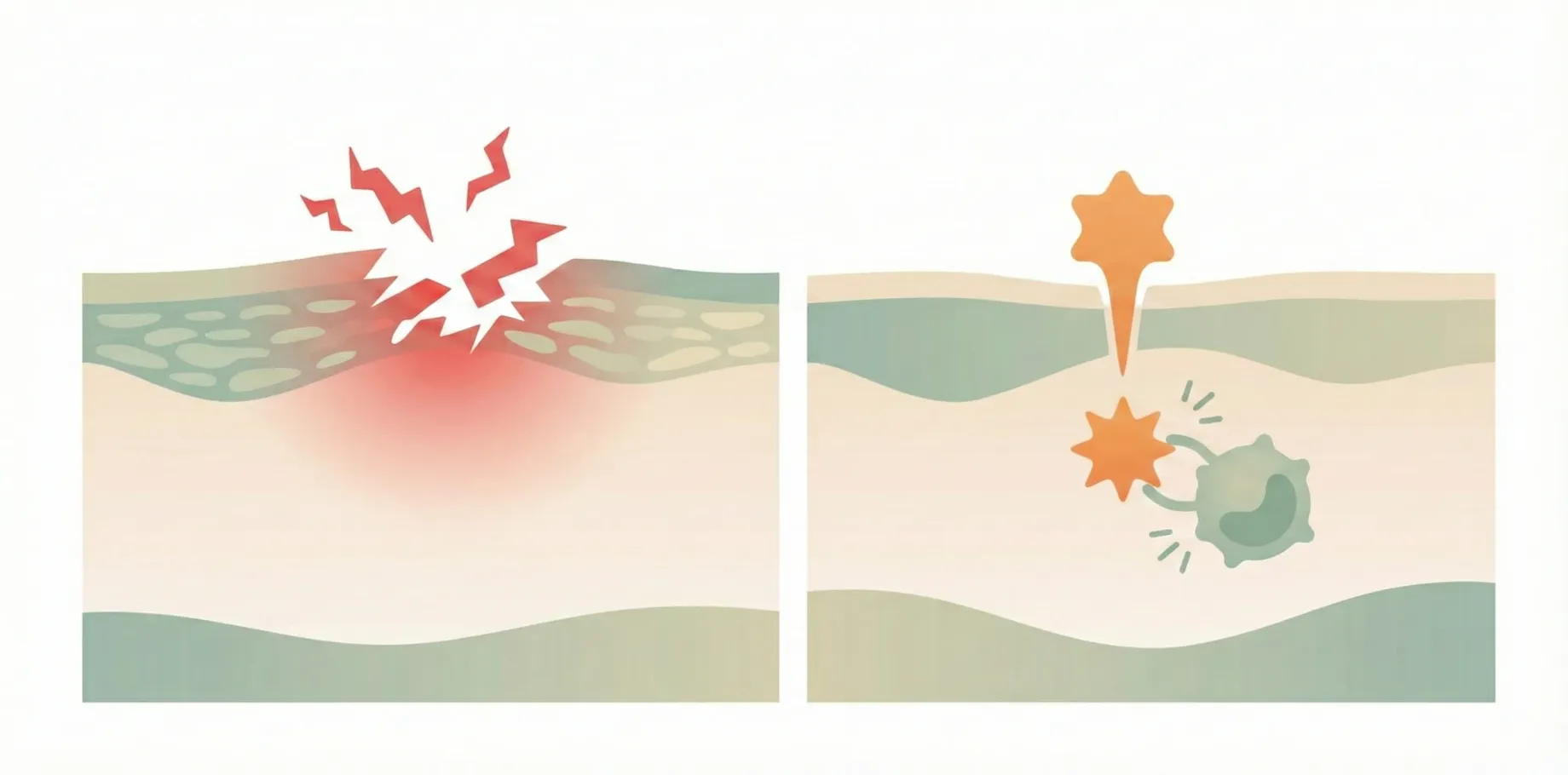
Two types: irritant vs allergic
Irritant Contact Dermatitis (ICD)
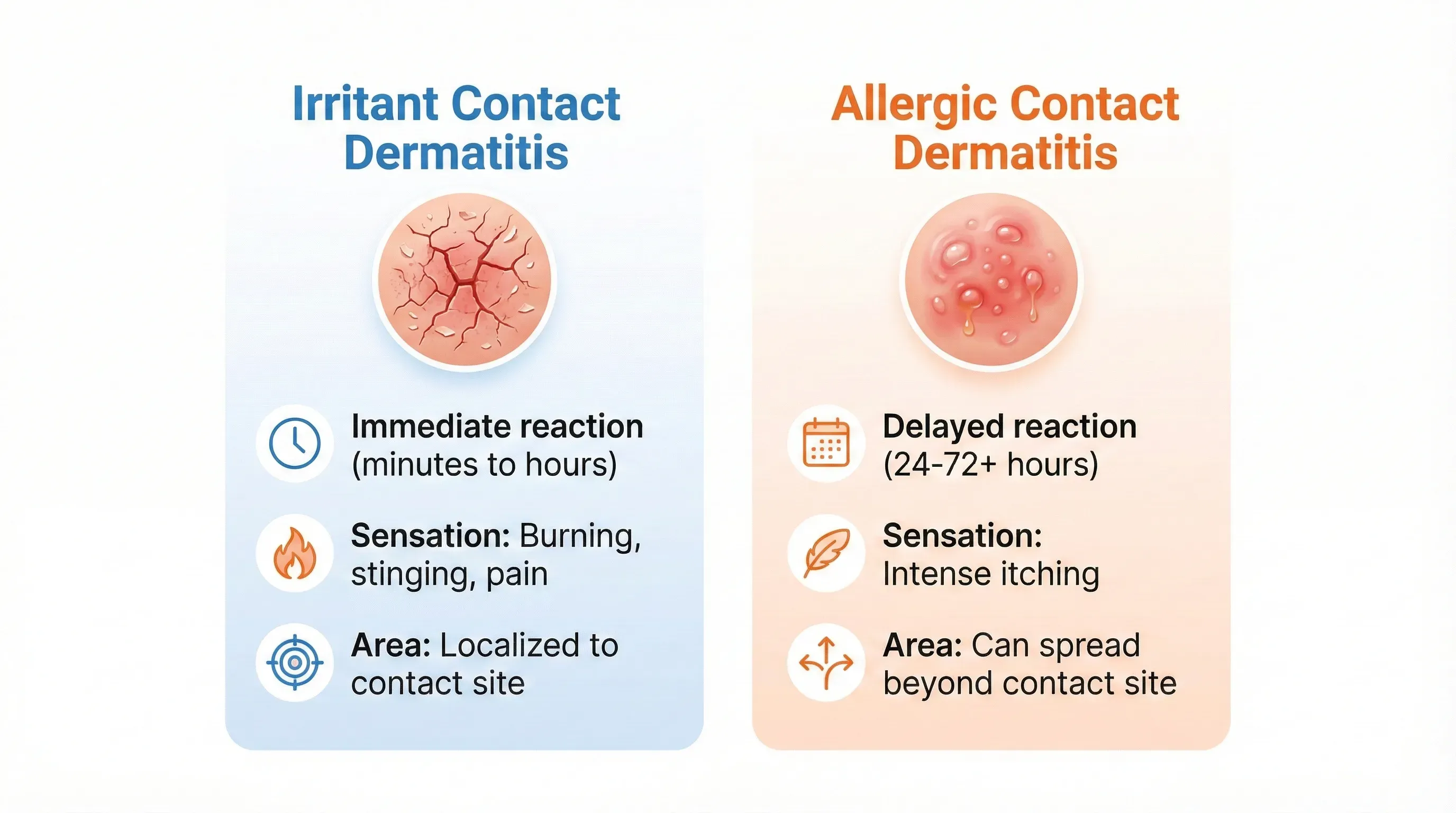
- More common (accounts for ~80% of cases)
- Happens when a product damages the skin barrier directly
- Can happen to anyone, first time use
- Usually localized to where the product touched
- Examples: harsh soaps, alcohol-based products, strong acids/bases
Allergic Contact Dermatitis (ACD)
- Less common but harder to identify
- Requires prior sensitization — your immune system must first "learn" the allergen
- Can develop after months or years of using the same product
- May spread beyond the contact area
- Common triggers: fragrances, preservatives (MI/MCI), hair dye (PPD), nickel
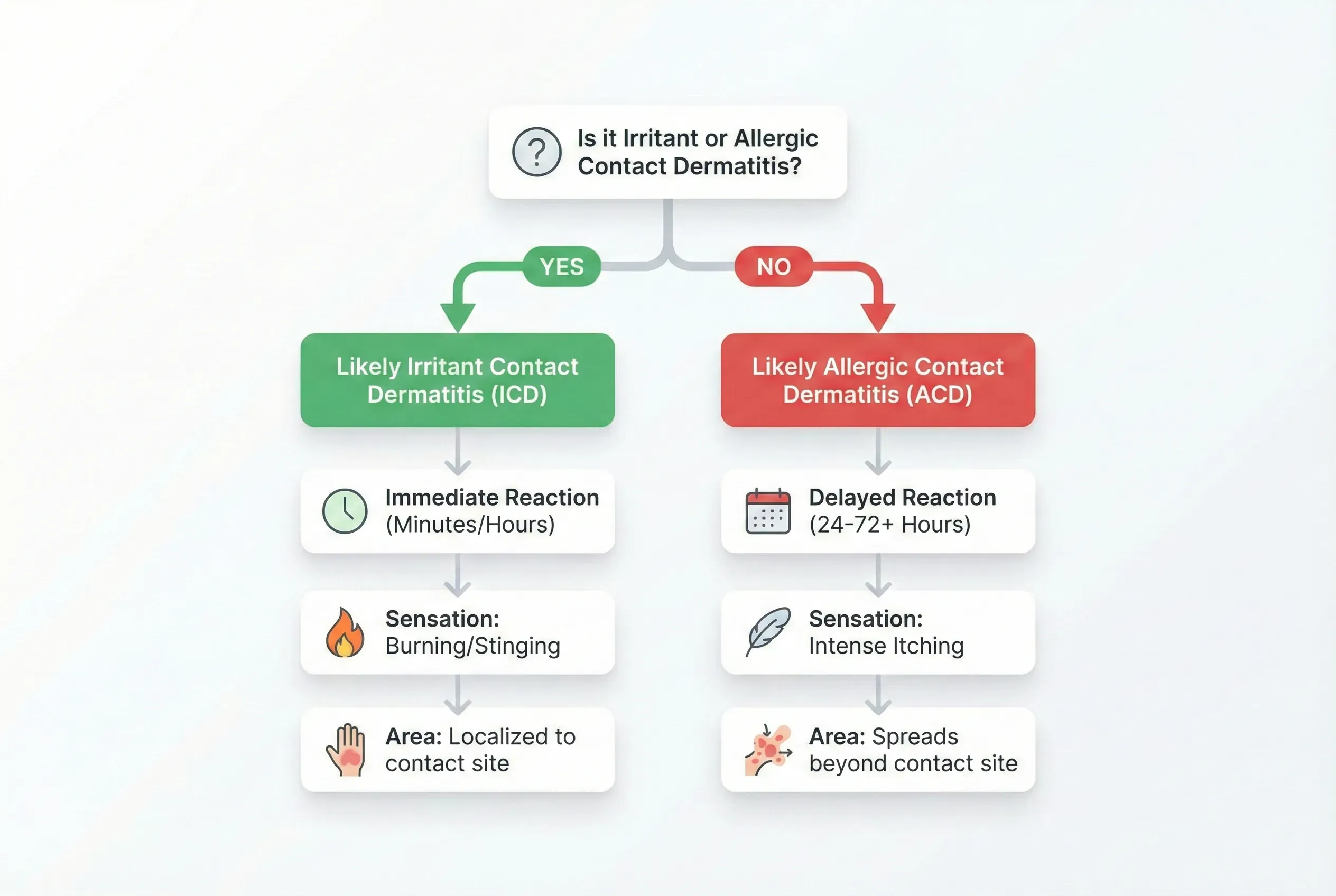
How do I tell which type I have?
| Feature | Irritant | Allergic |
|---|---|---|
| Timing | Usually immediate or within hours | 24-72 hours after contact |
| First exposure | Can happen first time | Requires prior sensitization |
| Area affected | Only where product touched | Can spread beyond contact site |
| Sensation | Burning, stinging | Itching is dominant |
| Appearance | Dry, cracked, chapped | Red, swollen, sometimes blistered |
If you can't tell which type you have, see a dermatologist. Allergic contact dermatitis requires patch testing to identify the exact trigger.
Most common cosmetic triggers
- Fragrances — #1 cause of cosmetic ACD
- Preservatives — MI, MCI/MI, formaldehyde releasers
- Hair dye chemicals — PPD (p-Phenylenediamine)
- Metals — Nickel (in eyeshadows, tools)
- Surfactants — SLS, SLES in cleansers
- Sunscreen filters — Oxybenzone, avobenzone
- Nail polish ingredients — Tosylamide, formaldehyde resin
Triggers that are easy to miss
Some of the most stubborn cases come from sources people don't file under "cosmetics" at all:
- "Black henna" temporary tattoos — spiked with PPD (the hair-dye allergen), these cause some of the most severe reactions, often in holidaymakers who had no idea they'd been sensitised
- "Natural", herbal and botanical products — essential oils and plant extracts are potent allergens, and ingredient lists on artisanal or imported products can be incomplete
- Transferred allergens — nail polish touched to the eyelids, hair dye on the hairline and neck, even a partner's products ("consort" dermatitis)
- Things you wear, not apply — rubber gloves, elastic waistbands, leather (chromium), watch straps, and fragrance in laundry products
The case that finally pushed me to build AllerNote was exactly this kind of misdirection — I was convinced an expensive serum was the problem when the real culprit was a preservative hiding in three different products at once. Cross-referencing the labels is what cracked it. That's the whole reason the scanner exists: your skin reacts to molecules, and molecules are easier to compare than marketing. — Snehal
What to do if you suspect contact dermatitis
Step 1: Stop the suspect product
If a new product caused the reaction, stop using it immediately. If you're not sure which product, start by eliminating the most recently added one.
Step 2: Simplify your routine
Reduce to 3 basics: gentle cleanser, fragrance-free moisturizer, and sunscreen. Use these for 2-3 weeks until skin calms down.
Step 3: Introduce products one at a time
Add back one product every 1-2 weeks. If a reaction returns, you've found your trigger.
Step 4: Consider patch testing
If you keep reacting and can't identify the trigger, ask a dermatologist about patch testing. This involves applying small amounts of common allergens to your back and checking for reactions over 48-96 hours.
Use AllerNote's scan feature to check the ingredients of suspect products. Compare the ingredient lists of products that cause reactions — look for common ingredients between them.
When to see a doctor
- Rash covers a large area or is near your eyes
- Blisters or oozing
- Reaction doesn't improve after 2 weeks of avoidance
- You can't identify the trigger
- Signs of infection (warmth, pus, increasing pain)
Prevention tips
- Patch test new products — apply a small amount to your inner forearm, wait 48 hours
- Read ingredient lists — shorter lists = fewer potential triggers
- Choose fragrance-free — not "unscented"
- Be cautious with "natural" — natural ingredients can be potent allergens
- Track your products — use AllerNote to maintain a safe/avoid list
Common reaction patterns by body area
Where the rash shows up often gives useful clues:
| Area | Common cosmetic triggers |
|---|---|
| Eyelids | nail polish transfer, shampoo runoff, fragrance, preservatives |
| Lips | lip balm, toothpaste, flavored products, fragrance |
| Scalp / hairline | hair dye, shampoo, styling products, fragrance |
| Neck | perfume, hair products, transferred allergens |
| Hands | soaps, sanitizers, detergents, nail products |
| Underarms | deodorant fragrance, propylene glycol, shaving products |
This is not diagnostic on its own, but it helps narrow the first suspects.
How to calm a flare while you investigate
When the skin is actively inflamed, detective work gets harder. First focus on reducing the flare:
- stop the newest or most suspicious products
- simplify to a bland moisturizer and a gentle cleanser
- avoid exfoliants, essential oils, and strong actives
- keep showers short and lukewarm
- follow your dermatologist's guidance if you were prescribed anti-inflammatory treatment
Trying five replacement products during an active flare usually creates more confusion, not answers.
What to bring to a dermatology appointment
If you need medical help, bring information that shortens the work-up:
- photos of the rash over time
- a list of products used in the 1-2 weeks before the reaction
- close-up photos of ingredient lists
- the timeline: what was new, what got worse, what improved after stopping
- whether the dominant symptom was itch, burn, or sting
These details are more useful than simply saying, "My skin is reacting to everything."
Common mistakes that delay the answer
- assuming "I used it for years, so it cannot be the problem"
- blaming the most expensive or strongest active when the trigger is actually fragrance or preservative
- changing the whole routine at once
- trusting labels such as "natural," "gentle," or "hypoallergenic"
- patch testing new products on already-inflamed facial skin
Contact dermatitis is frustrating precisely because the real trigger is often more ordinary than people expect.
Can two problems happen at once?
Yes. Many people have more than one issue at the same time:
- eczema plus irritant dermatitis
- allergic contact dermatitis plus overuse of active ingredients
- scalp irritation plus hair dye allergy
This is why the answer is sometimes "your skin is both inflamed and allergic." A simplified routine helps you see the allergy layer more clearly.
Bottom line
If you remember only one thing, make it this: contact dermatitis is usually solved by better observation, not by buying more products. The most useful steps are to simplify, document, compare labels, and test changes slowly.
Keep the process boring on purpose. Boring routines are easier to diagnose, easier to stabilize, and easier to trust.
FAQ
Can contact dermatitis go away on its own?
Yes, if you avoid the trigger. Irritant dermatitis typically resolves within 2-4 weeks. Allergic dermatitis may take longer.
Can I develop allergies to products I've used for years?
Yes. Allergic contact dermatitis requires sensitization, which can happen after months or years of repeated exposure.
Is contact dermatitis the same as eczema?
Contact dermatitis is a type of eczema, but eczema (atopic dermatitis) can occur without a specific trigger. People with eczema are more prone to contact dermatitis.

The Patch-Test Tracker & Journal
Turn your patch-test results into a system you can actually shop with.