Why eczema changes how you approach skincare
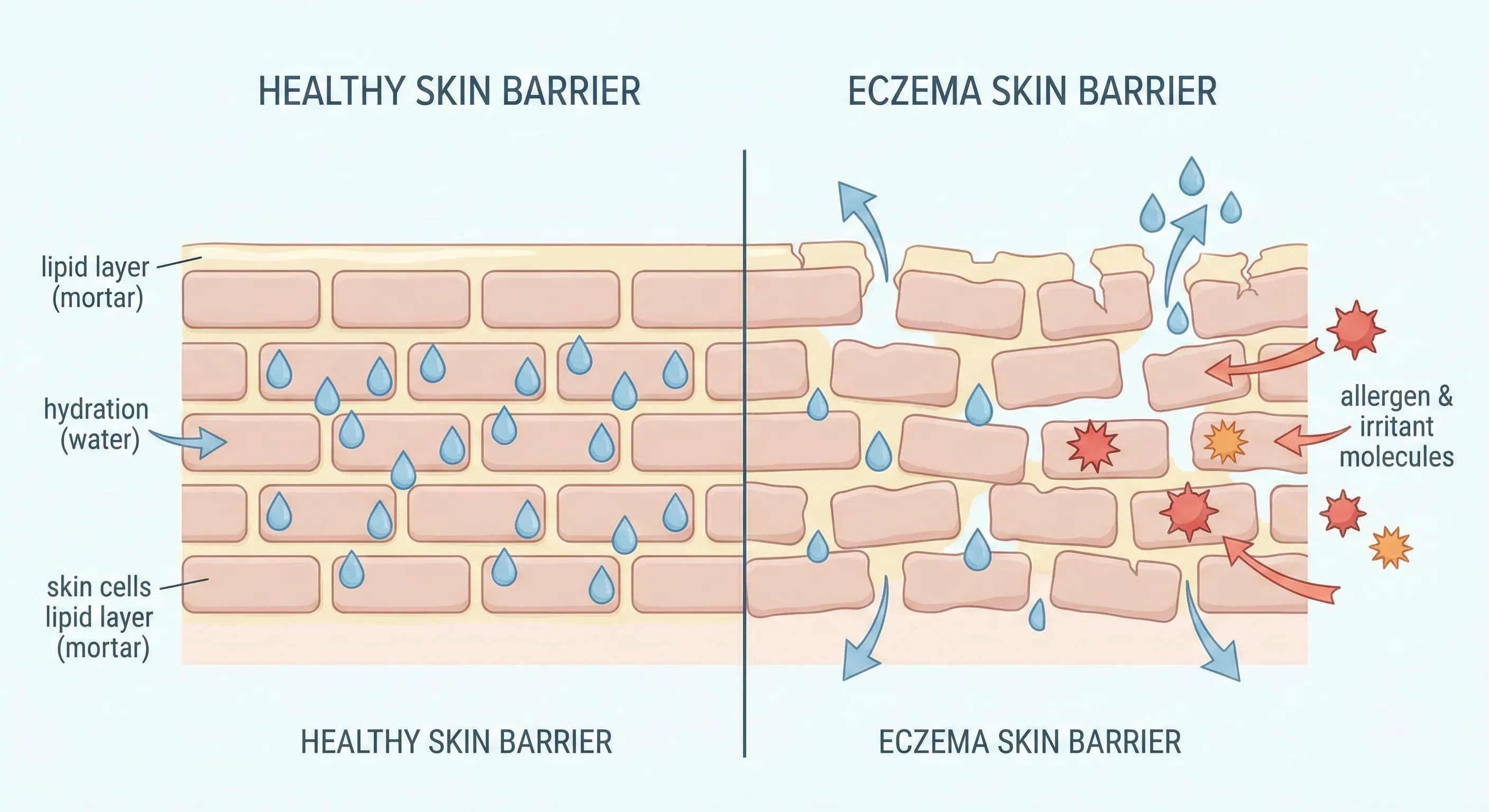
If you have eczema (atopic dermatitis), your skin barrier doesn't function normally. Think of healthy skin as a brick wall — the cells are bricks and the lipids (fats) between them are mortar. In eczema, the mortar is weak:
- Moisture escapes more easily → dry skin
- Irritants and allergens penetrate more easily → reactions
- You're more susceptible to contact dermatitis from cosmetics
This means ingredients that most people tolerate fine can trigger flare-ups on eczema skin.
Eczema skin reacts to cosmetics 2-3x more often than normal skin. What works for your friends may not work for you — and that's okay.
Ingredients to avoid with eczema
Definitely avoid
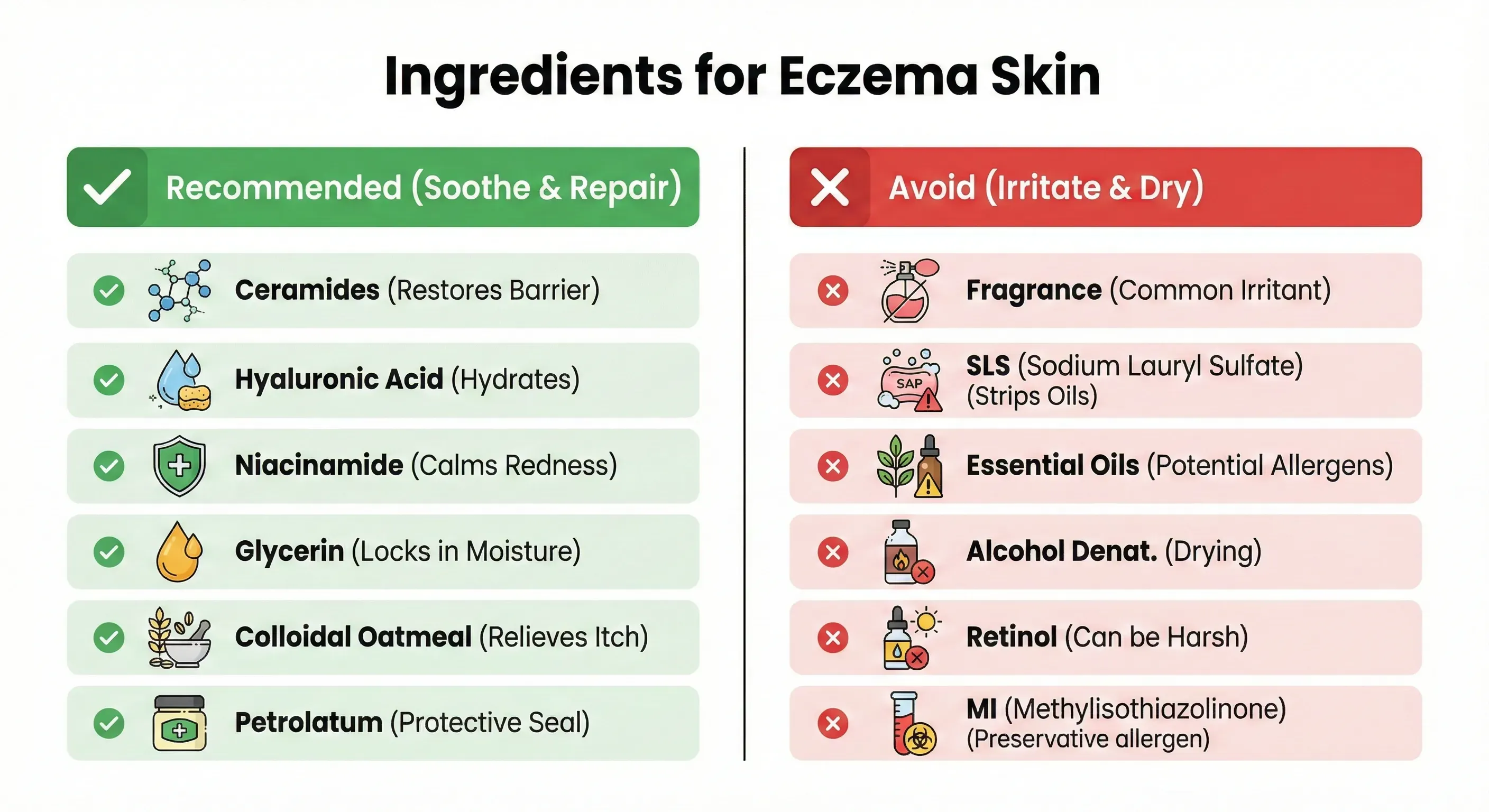
- Fragrance / Parfum — #1 irritant for eczema skin
- Essential oils — concentrated plant compounds; common sensitizers
- Sodium Lauryl Sulfate (SLS) — harsh surfactant that strips skin barrier
- Alcohol Denat / SD Alcohol — drying, damages barrier
- Methylisothiazolinone (MI) — potent preservative allergen
- Formaldehyde releasers (DMDM Hydantoin, Imidazolidinyl Urea)
Be cautious with
- Retinol / Retinoids — can be very irritating during flares
- Alpha Hydroxy Acids (AHAs) — glycolic, lactic acid - too harsh for active eczema
- Vitamin C (L-Ascorbic Acid) — at high concentrations, low pH can sting
- Witch Hazel — often contains alcohol, can irritate
- Physical exfoliants — scrubs damage compromised barriers
Generally safe
- Ceramides — actually help repair the barrier
- Hyaluronic Acid — hydrating, well-tolerated
- Niacinamide — anti-inflammatory, barrier-supporting
- Glycerin — gentle humectant
- Petrolatum / Vaseline — excellent barrier protectant
- Colloidal Oatmeal — soothing, anti-itch
The ideal eczema skincare routine
Morning
- Gentle cleanser — fragrance-free, SLS-free, cream or micellar
- Moisturizer — ceramide-rich, fragrance-free, applied to damp skin
- Sunscreen — mineral (zinc oxide), fragrance-free
Evening
- Gentle cleanser — same as morning
- Prescription treatments — if any, apply as directed by your dermatologist
- Heavy moisturizer or ointment — lock in hydration overnight
Apply moisturizer within 3 minutes of washing. This locks in the water your skin absorbed. This single habit can dramatically reduce eczema dryness.
What to look for on labels
Green flags:
- "Fragrance-free" (not "unscented")
- Short ingredient list (10-15 ingredients)
- Contains ceramides, hyaluronic acid, or glycerin
- "Non-comedogenic" (won't clog pores)
- National Eczema Association seal (if available)
Red flags:
- "Parfum" or "Fragrance" anywhere in the list
- Essential oils listed (lavender, tea tree, citrus, etc.)
- SLS or SLES as the primary surfactant
- "Natural" or "herbal" (these often contain plant allergens)
- Very long ingredient list
Home remedies and "natural" products — proceed carefully
Some traditional and "natural" fixes genuinely help; others quietly make eczema worse:
- Coconut oil — a popular remedy with some evidence for mild moisturising and antibacterial benefit, but it's comedogenic for some people and a minority react to it. Try it cautiously, not as a given.
- Plant / "Ayurvedic" / herbal products — frequently heavily fragranced or full of essential oils; check the ingredient list even when the front of the pack says "natural" or "gentle."
- Massage oils — some (e.g. mustard oil) contain irritants such as allyl isothiocyanate that can aggravate already-broken skin.
- The reliable, cheap options — plain petrolatum and glycerin are about as evidence-based as barrier care gets, at any budget.
When to see a dermatologist
Book a visit if:
- eczema covers large areas of your body
- you flare more than once a month
- over-the-counter moisturisers aren't helping
- there are signs of infection (yellow crusting, warmth, pus, increasing pain)
- the itch is disrupting your sleep or daily life
A clinician can prescribe anti-inflammatory treatment for flares and, if a specific product keeps triggering you, arrange patch testing to find the culprit.
Building your safe product list
- Start with 3 products only — cleanser, moisturizer, sunscreen
- Introduce one new product at a time — wait 2 weeks between additions
- Keep a reaction diary — note which products you used and any symptoms
- Scan everything — use AllerNote to check ingredient lists before buying
- Save your safe products — build a personal safe list to reference while shopping
Create your allergy profile in AllerNote with common eczema triggers (fragrance, SLS, MI, etc.). Then scan any product before buying — the app will flag ingredients that may trigger your eczema.
How to choose each part of the routine
Cleanser
The best eczema cleanser is often the least exciting one. Look for:
- low-foam or cream textures
- no fragrance
- no scrubs
- no "deep clean" claims
If water alone works in the morning, that is a valid option for many eczema-prone faces.
Moisturizer
This is the highest-value product in the routine. Good signs:
- ceramides, glycerin, petrolatum, squalane, hyaluronic acid
- tube or pump packaging
- simple texture you will actually use daily
For very dry or cracked skin, an ointment or balm may work better at night than a light lotion.
Sunscreen
Many people with eczema do best starting with a fragrance-free mineral sunscreen. If it feels too heavy, try a hybrid formula, but keep the rest of the routine calm while testing it.
Signs it might be contact allergy on top of eczema
Not every flare is "just eczema." Consider allergic contact dermatitis as an add-on problem if:
- a specific product burns every time you use it
- the rash is worst on eyelids, neck, lips, or hands
- you keep flaring despite using eczema-focused products
- a once-safe product suddenly becomes intolerable
- the pattern clearly follows product contact
This is one reason patch testing can be so useful for people with eczema. Barrier damage and allergy often overlap.
Common mistakes that keep eczema irritated
- trying too many serums once the skin starts improving
- using heavily fragranced body care because the face seems fine
- washing with hot water and then skipping moisturizer
- chasing "natural" formulas that contain essential oils
- assuming a product is safe because it says "for sensitive skin"
In practice, eczema care is often less about adding special products and more about removing the extra noise.
Seasonal checklist
When weather changes, your routine may need to change too:
- winter: richer moisturizer, less hot water, more ointment at night
- summer: lighter layers, faster sweat removal, careful fragrance avoidance
- monsoon / humidity: keep folds dry and watch for secondary irritation from sweat and friction
The product is not always the whole story. Climate can change the same formula from "fine" to "too much."
I'm not a dermatologist — I'm an engineer who got patch-tested and went down the rabbit hole. The single most counter-intuitive lesson for me was that doing less worked better than any clever product. Every time my skin calmed down, I'd get excited and start adding serums again, and every time it punished me for it. If you take one thing from this page, let it be permission to keep your routine boring. — Snehal
Bottom line
For eczema-prone skin, the routine that wins is usually the simplest one you can repeat every day: gentle cleanse, moisturize early, protect the barrier, and keep fragrance low. Consistency beats novelty.
FAQ
Can eczema go away permanently?
Many children outgrow eczema. In adults, it can go into long remissions but may flare during stress, weather changes, or new exposures. Good skincare habits help maintain remission.
Should I use prescription creams daily?
Follow your dermatologist's guidance. Topical steroids are for flare-ups, not daily maintenance. Moisturizers are for daily use.
Is "eczema cream" on the shelf actually helpful?
Some are. Look for ones with ceramides, colloidal oatmeal, or petroleum jelly as key ingredients. Avoid those with fragrances — even ones marketed for eczema sometimes contain them.
Can stress cause eczema flares?
Yes. Stress is a well-documented eczema trigger. Managing stress through exercise, sleep, and relaxation can help reduce flare frequency.
The AM / PM Routine Planner
Lay out your morning and evening routine — and schedule actives so they don’t clash.