What are parabens?
Parabens are preservatives used to prevent bacteria and mold growth in cosmetics. Common parabens include:
- Methylparaben
- Ethylparaben
- Propylparaben
- Butylparaben
They’re popular because they’re effective at low concentrations and help keep products stable and safe.
Why do people avoid parabens?
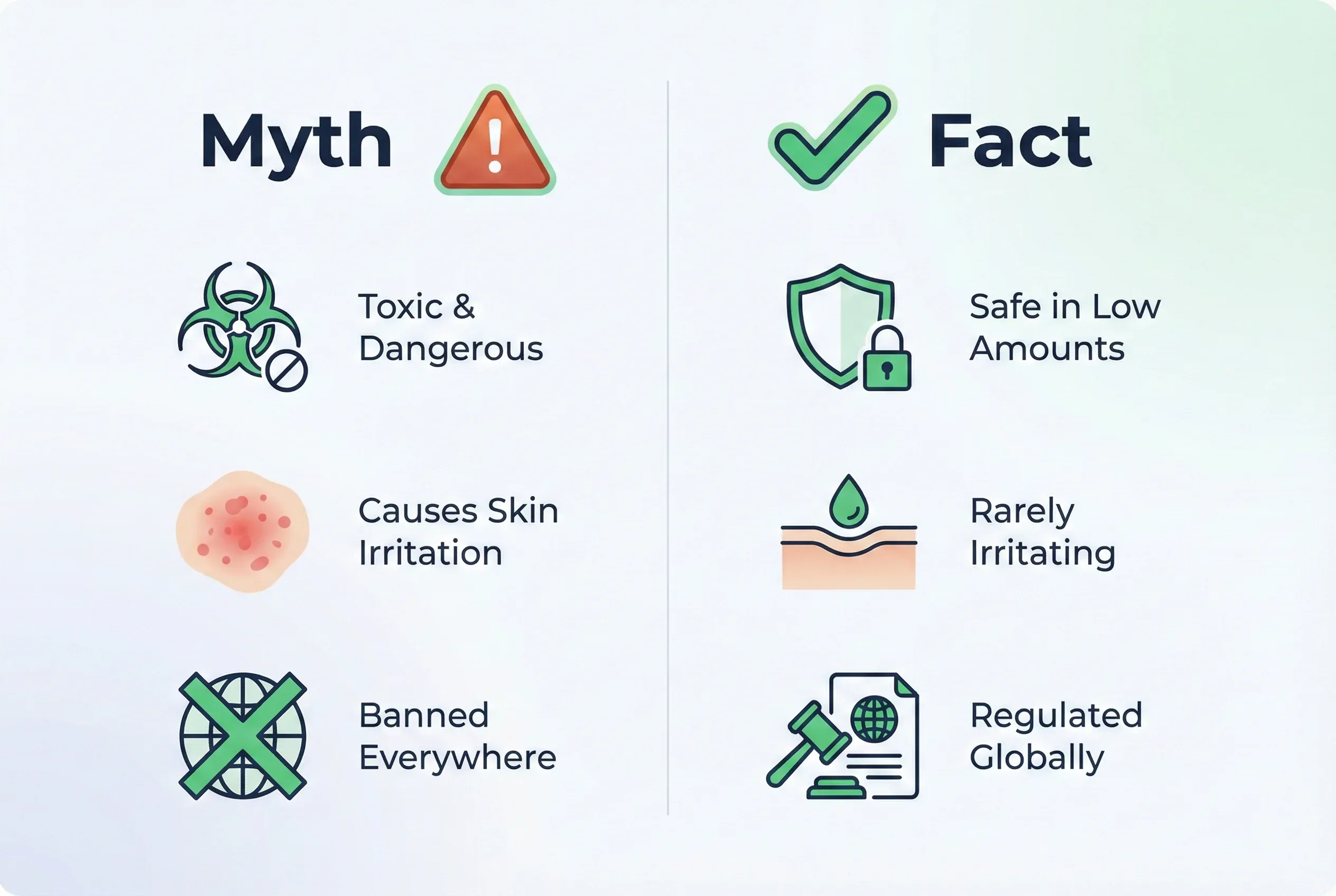
The controversy largely comes from concerns about hormone (estrogen) activity. The practical takeaway for most users:
- Regulatory bodies have repeatedly reviewed parabens.
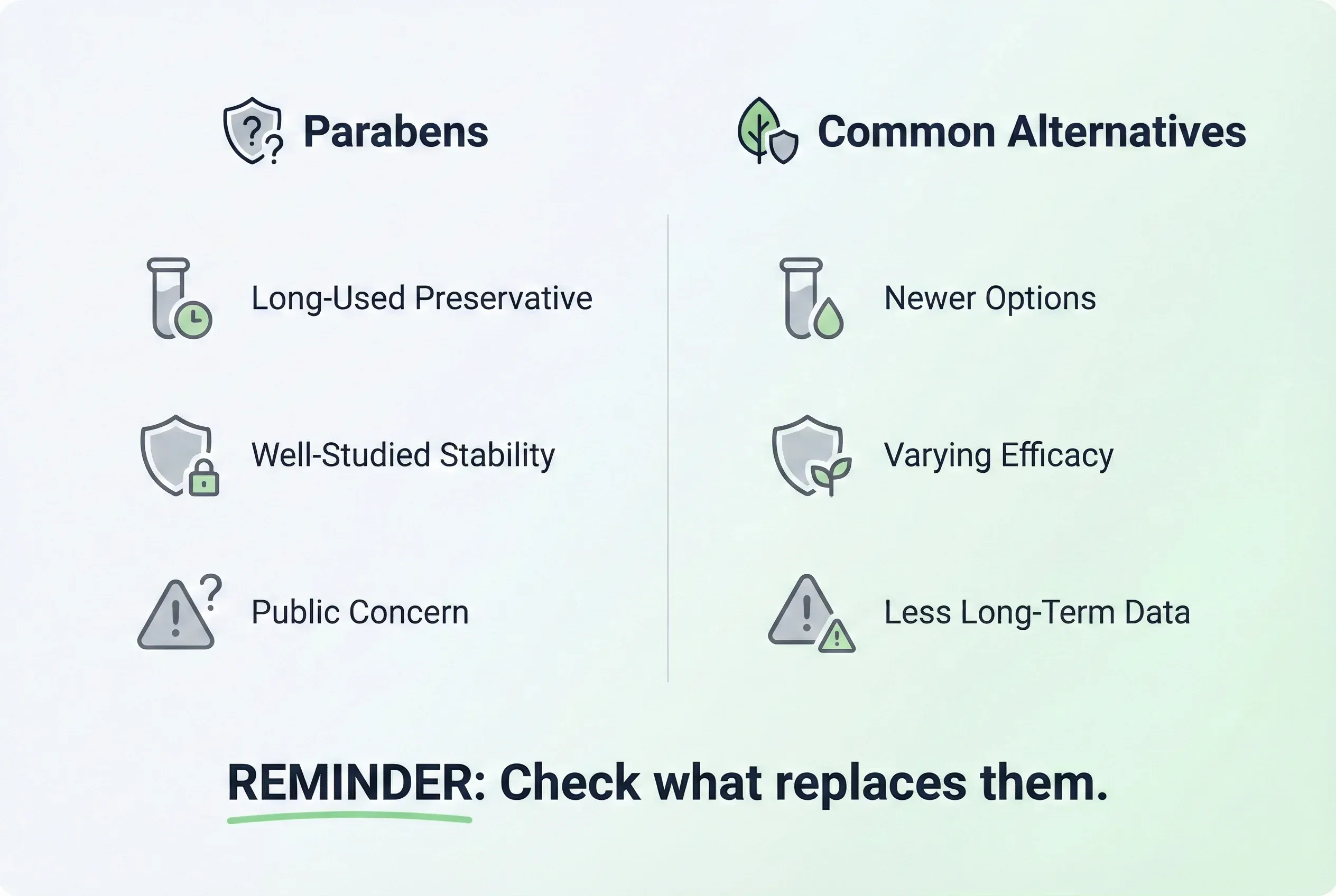
- Many consumers still prefer to avoid them — and that’s okay — but the replacement preservative system matters.
“Paraben-free” doesn’t automatically mean safer for sensitive skin. Some paraben-free products use preservatives that are more likely to cause allergy (for example, certain isothiazolinones like MI/MCI).
Quick label check (how to spot parabens)
Look for ingredients ending in “-paraben”:
- Methylparaben, Propylparaben, Butylparaben, Ethylparaben, Isobutylparaben
What to choose if you’re sensitive
If you’re avoiding parabens for comfort or preference, consider products that use preservative systems many people tolerate well, such as:
- Phenoxyethanol (common)
- Sodium benzoate + potassium sorbate (common in gentler formulas)
- Airless packaging that allows lower-preservative formulas
"Paraben-free" is a marketing claim, not a safety upgrade
"Paraben-free" is plastered across nearly every category now, and it sells — but on its own it tells you nothing about how a product will treat your skin. It's the same trap as "hypoallergenic": a reassuring label with no agreed standard behind it. For sensitive skin, the useful sequence is:
- Decide your actual position — avoid parabens, or fine with them — rather than absorbing it from the packaging.
- Read what replaced them. A paraben-free formula preserved with MI/MCI may be more likely to cause allergy, not less.
- Change one thing at a time. Small, tracked swaps reveal far more than a panicked whole-routine overhaul.
I'll be honest: as an engineer, parabens are the ingredient where the gap between the online fear and the actual data bothers me most. They're among the least likely preservatives to cause a reaction, yet "paraben-free" became a badge of safety — often on products preserved with something more sensitising. I built AllerNote partly to push back on exactly this: react to what the evidence and your own skin say, not to whichever ingredient the internet decided to fear this year. — Snehal
Why parabens stayed popular for decades
Parabens remained common in cosmetics for a simple reason: they work well at low concentrations and have a long record of use. From a formulation perspective, that matters a lot. A preservative is not there for marketing. It is there to help prevent contamination from bacteria, yeast, and mold after a product is opened and used repeatedly.
In practical terms, formulators liked parabens because they were:
- effective across a broad range of microbes
- compatible with many cosmetic textures
- stable in creams, lotions, gels, and makeup
- usually well tolerated compared with some newer alternatives
That last point is easy to miss in social media conversations. A preservative can be unpopular online and still be comparatively less irritating than the ingredient that replaced it.
What the science debate actually says
The paraben debate is usually framed in a way that is too simple. Three points help keep it grounded:
1. Hazard is not the same as real-world exposure
Many ingredients can show some biological activity in laboratory settings. What matters for consumers is how they are actually used in finished products, at what concentration, and what regulators and safety reviewers conclude from the total evidence.
2. Preservatives are a safety feature
If a water-based cosmetic is under-preserved, it can spoil or become contaminated. For people with eczema, damaged skin, or periocular use, a contaminated product can create a much bigger problem than the preservative itself.
3. "Paraben-free" is not a synonym for "better for sensitive skin"
Some paraben-free formulas rely on preservative systems that are more likely to sting, dry out skin, or trigger allergy in sensitive users. That does not mean parabens are mandatory; it means the replacement system deserves the same scrutiny.
Instead of asking only "Does this contain parabens?", ask "What preserves this formula, and how does my skin usually react to that preservative system?"
When avoiding parabens makes sense
Avoidance can make sense in a few situations:
- you have a documented paraben allergy from patch testing
- a specific product family repeatedly irritates your skin and you want a simple elimination trial
- you have a strong personal preference and understand the trade-offs
What does not make sense is assuming that every paraben-free product is automatically a better choice for eczema, rosacea, acne-prone skin, or contact dermatitis.
How to compare preservative systems in real life
When two products look similar, compare these details:
| Question | Why it matters |
|---|---|
| Is it fragrance-free? | Fragrance is more often the real trigger than parabens |
| What is the replacement preservative? | MI/MCI and some formaldehyde releasers are more problematic for allergy-prone users |
| Is it a leave-on or rinse-off product? | Leave-on exposure matters more |
| Is the formula simple? | Fewer variables makes reactions easier to interpret |
| Does your skin barrier already feel damaged? | Compromised skin stings more easily from many ingredients |
A quick decision framework
If a paraben-containing product is fragrance-free, simple, and your skin already likes it, keep a high bar before replacing it. If a paraben-free product is strongly scented, complex, or irritating, the "free-from" claim does not save it. Sensitive skin usually does better with evidence and consistency than with ingredient panic.
Bottom line
Parabens are not the highest-yield villain for most people with reactive skin. If you want to avoid them, do it intentionally - and always judge the replacement formula, not only the front label.
What usually matters more than parabens
For most people with sensitive or eczema-prone skin, these factors usually matter more:
- fragrance
- harsh cleansers
- overuse of acids and retinoids
- complicated routines with many leave-on products
- damaged barrier function
That perspective helps keep parabens in proportion instead of letting them dominate every buying decision.
It also protects you from replacing a stable product with a trendier formula that is actually harder for your skin to tolerate.
If a product is otherwise excellent for your skin, "contains parabens" is usually not the strongest reason to abandon it.
That kind of restraint matters because stable routines are often healthier than constantly optimized ones.
For sensitive skin, "works consistently" is often a more valuable outcome than "wins a social-media ingredient debate."
That is the mindset that usually produces the safest routine in practice.
It is also the mindset that makes patch testing and reaction tracking easier to interpret.
Better data always beats louder fear. That rule holds up surprisingly well in skincare. Calm skin usually proves the point better than trends do. Your own skin history is still the strongest judge.
A practical way to trial paraben-free products
If you want to test whether avoiding parabens helps your skin, do it methodically:
- Change only one category first, such as moisturizer.
- Keep the rest of your routine stable for 2-3 weeks.
- Choose a fragrance-free product with a short ingredient list.
- Note the replacement preservative system.
- If the new product is worse, do not assume your skin "hates skincare" - review what replaced the parabens.
FAQ
Are parabens more likely to cause allergy than MI or fragrance?
In practice, fragrance and certain isothiazolinone preservatives are much more common causes of cosmetic allergy complaints than parabens. For many sensitive-skin users, fragrance elimination is the higher-yield move.
Should I avoid parabens if I have eczema?
Not by default. Barrier damage, fragrance, harsh cleansers, and overuse of actives are often more important. If a paraben-containing product works well for your eczema-prone skin, the presence of parabens alone is not a reason to stop.
Is a moldy paraben-free product safer because it avoids parabens?
No. Any product that looks, smells, or feels contaminated should be discarded. Preservative failure is not a benefit.
Related Ingredient Pages
Want to learn more about specific ingredients? Browse our detailed guides:
- Methylparaben — most common paraben preservative
- Propylparaben — widely used paraben preservative

The Cosmetic Allergen Cheat Sheets
The allergens behind most reactions — and the names they hide under.