Why ingredient labels matter
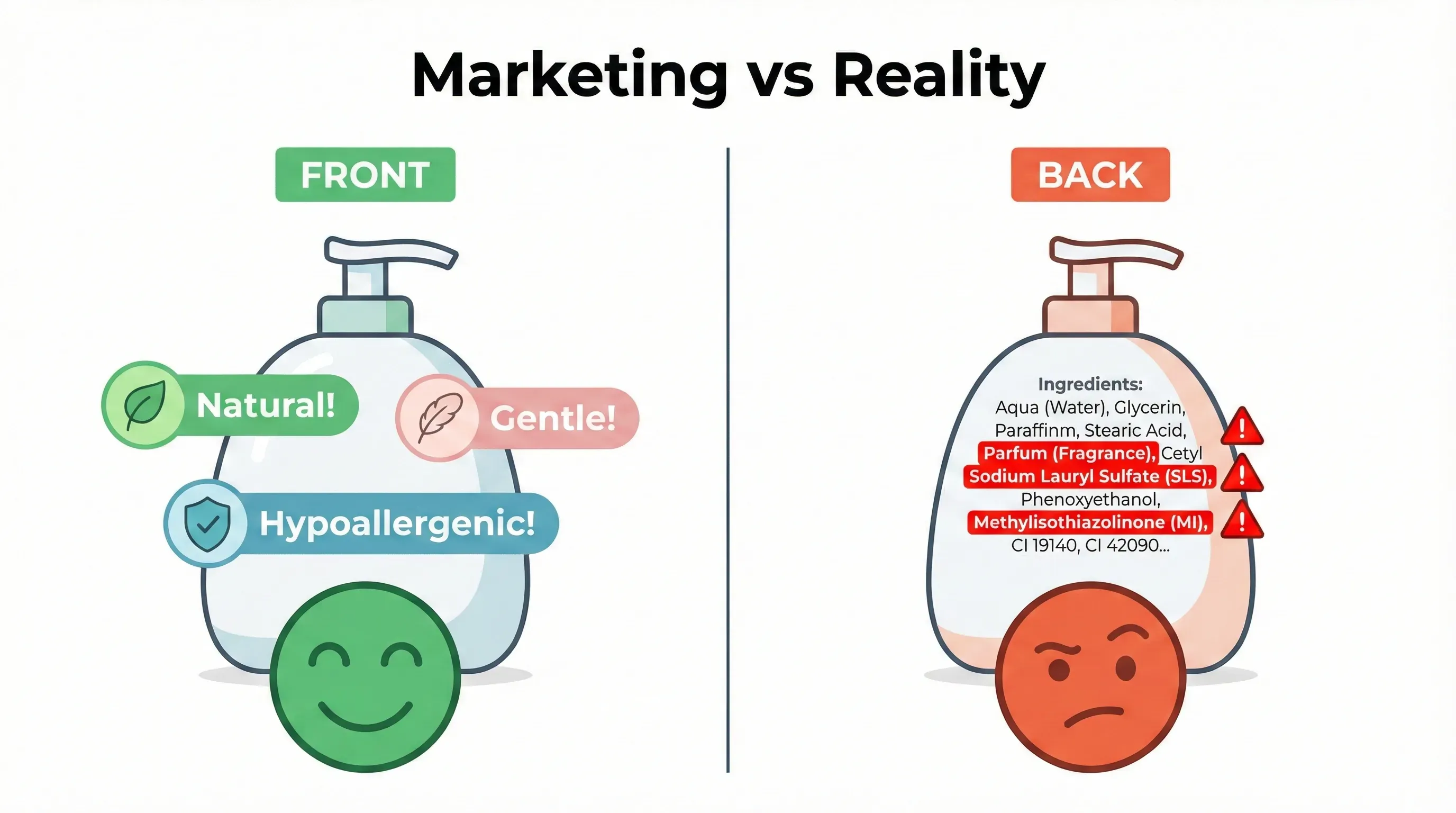
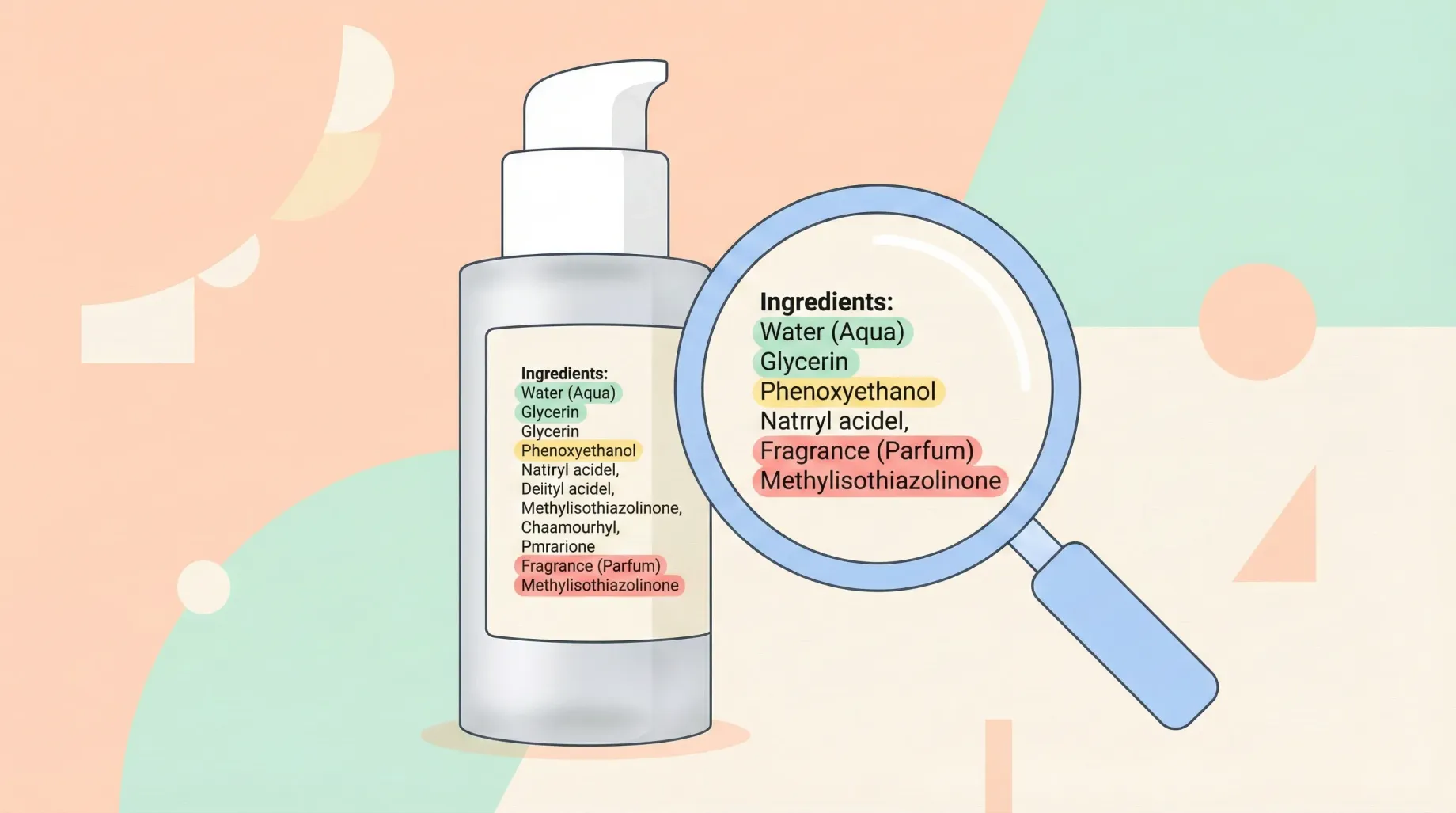
The front of a cosmetic product is marketing. The back — specifically the ingredient list — is where the truth lives. Understanding how to read it is the single most useful skill for anyone with sensitive skin.
You don't need to memorize hundreds of chemical names. Just learn the 5-10 common allergens and irritants relevant to your skin — and you'll be able to quickly scan any label.
The basics: how ingredient lists work
1. Descending order rule
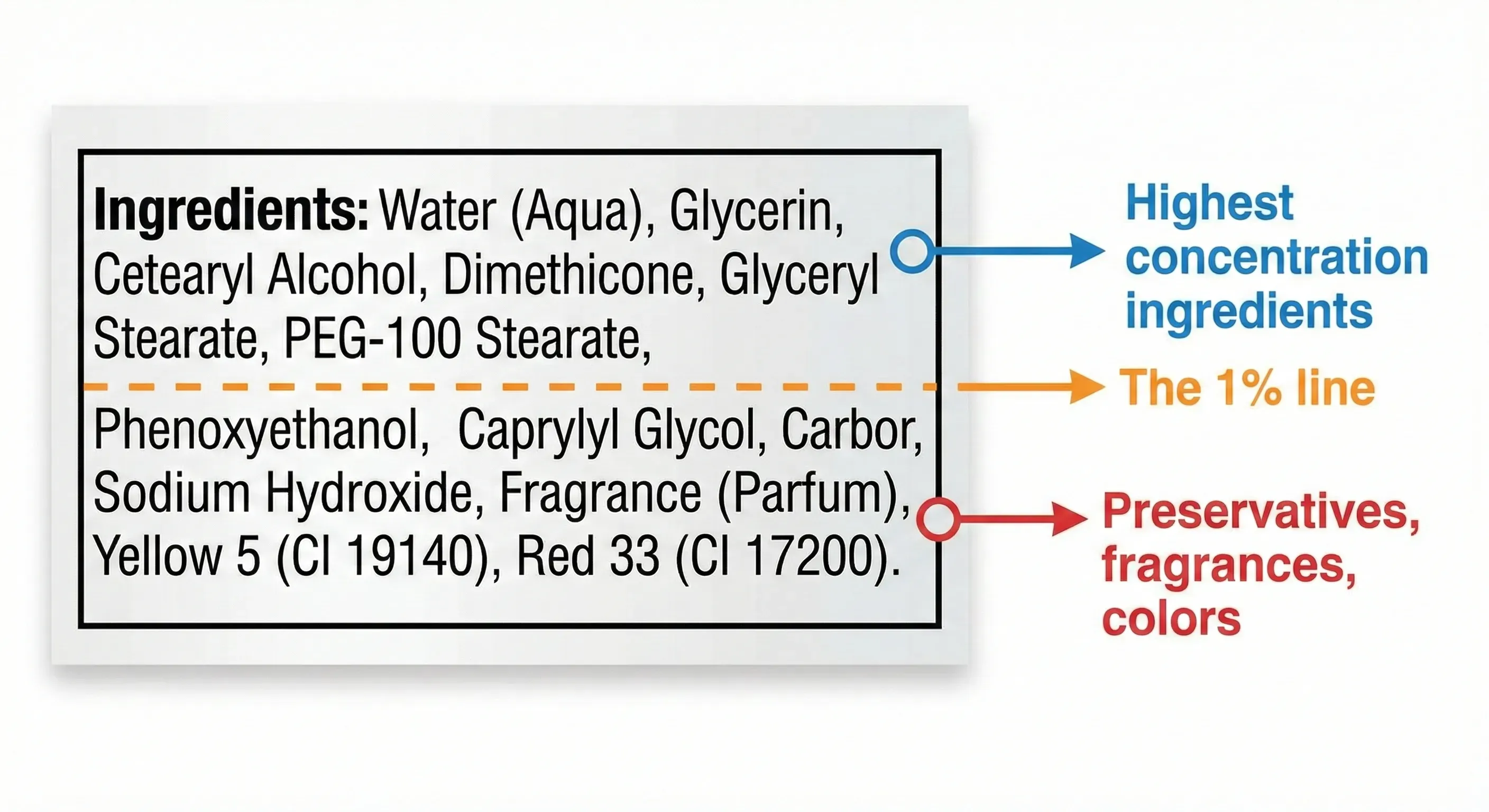
Ingredients are listed from highest concentration to lowest. The first few ingredients make up the bulk of the product.
Example:
Water, Glycerin, Cetearyl Alcohol, Dimethicone, Fragrance...
Water is the main ingredient. Glycerin is the second most abundant. By the time you reach "Fragrance," it's a small percentage — but still enough to cause reactions.
2. The 1% line
Ingredients present at less than 1% can be listed in any order. This is where preservatives, fragrances, and active botanicals typically appear.
How to spot the 1% line: Look for ingredients like preservatives (phenoxyethanol, sodium benzoate), colorants (CI numbers), and fragrances. Everything from this point onward is usually under 1%.
3. INCI names
Most products use INCI (International Nomenclature of Cosmetic Ingredients) names. These are standardized but can look intimidating:
| INCI Name | What it actually is |
|---|---|
| Aqua | Water |
| Sodium Lauryl Sulfate | A foaming agent (surfactant) |
| Tocopheryl Acetate | Vitamin E |
| Butyrospermum Parkii | Shea Butter |
| Parfum / Fragrance | Scent blend (can contain 100+ chemicals) |
| Methylisothiazolinone | A preservative (common allergen) |
| CI 77891 | Titanium Dioxide (white pigment) |
Red flags to watch for
1. "Fragrance" or "Parfum"
This is a catch-all term that can hide dozens of individual scent chemicals. It's the #1 cosmetic allergen.
2. Very long ingredient lists
More ingredients = more potential triggers. For sensitive skin, shorter is usually better.
3. Marketing vs reality
| Front of pack says... | But the ingredient list may show... |
|---|---|
| "Natural" | Synthetic preservatives, fragrances |
| "Dermatologist tested" | Just means a dermatologist looked at it, not that it's safe for you |
| "Hypoallergenic" | No legal definition — can still contain allergens |
| "Unscented" | May contain masking fragrances |
| "Paraben-free" | May use other preservatives that are equally irritating |
"Dermatologist recommended" and "clinically tested" have no standardized legal meaning anywhere. Always check the actual ingredient list.
US vs EU labels: the differences worth knowing
INCI is an international system, so most ingredient names look the same wherever you shop — but a few conventions differ and trip people up:
| Convention | US | EU (and many other markets) |
|---|---|---|
| Water | usually "Water" | usually "Aqua" |
| Colourants | "FD&C / D&C colour no." | CI numbers (e.g. CI 77891) |
| Fragrance allergens | bundled inside "Fragrance" | ~80 named separately above a threshold (Linalool, Limonene…) |
| Sunscreen / anti-acne actives | in a separate "Active Ingredients" box | listed within the INCI list |
Two practical upshots. On an EU label, the individual fragrance-allergen names listed after "Parfum" are a gift — they tell you exactly which regulated allergens are present. And botanical Latin names are INCI standard everywhere, so "natural"-marketed products routinely hide familiar plants behind Latin: Butyrospermum Parkii is shea butter, Curcuma Longa is turmeric, Rosa Damascena is rose. If you react to a specific botanical, learning its Latin name is what lets you actually spot it.
How to use this knowledge practically
- Photograph ingredient lists — they're easier to read digitally (zoom in)
- Learn your personal triggers — keep a list of ingredients that cause reactions
- Compare products — if Product A is safe and Product B causes a reaction, compare their ingredient lists to find the difference
- Use AllerNote — scan any label and get instant analysis without memorizing INCI names
When you find a product that works perfectly for you, save its ingredient list. Use it as a reference when trying new products — look for similar formulations.
What the first five ingredients usually tell you
You do not need to understand every ingredient to get value from a label. The first five often tell you the product category and "feel":
- Water + humectants + emollients usually means a basic lotion or serum base
- surfactants near the top usually means a cleanser
- silicones high up often means a smoothing, slip-heavy formula
- multiple oils and butters early often means a richer cream or balm
- alcohol high on the list may predict a lighter feel but also more sting for reactive skin
This gives you a fast first impression before you worry about niche ingredients.
Ingredients that often matter most for sensitive skin
For practical shopping, train yourself to spot these groups:
Fragrance terms
Fragrance, Parfum, Aroma, essential oils, and common fragrance allergens such as linalool or limonene.
Preservatives
MI, MCI, phenoxyethanol, parabens, sodium benzoate, formaldehyde releasers.
Surfactants
SLS, SLES, CAPB, glucosides, isethionates.
Colorants and pigments
CI numbers, especially in makeup and tinted products.
Botanical extracts
Useful for marketing, but sometimes a source of allergy or confusion if there are too many.
Why online shopping makes label reading harder
Online product pages often create three problems:
- the ingredient list is incomplete or hidden in a dropdown
- the page shows marketing claims but not the full INCI list
- the seller mixes old and new packaging, so the label you see may not match the one you receive
When shopping online, try to find the full current ingredient list, not only the feature bullets.
A 5-minute label audit anyone can do
If you want a repeatable routine, use this quick audit:
- Ignore the front of the pack for the first 30 seconds.
- Read the first five ingredients to understand the base.
- Scan for your known triggers: fragrance, preservatives, surfactants, metals, dyes, or botanicals.
- Check the bottom of the list for preservatives and fragrance allergens.
- Decide whether the formula looks simpler, similar to a safe product, or riskier than what already works for you.
This is usually enough to rule products in or out quickly.
Common label myths that confuse shoppers
- "If it is low on the list, it cannot matter." False: preservatives and fragrance are often low on the list but still very relevant.
- "A long ingredient list means a better formula." False: more ingredients often means more chances for mismatch.
- "Natural names are safer than chemical names." False: plant ingredients can be allergens too.
- "If I cannot pronounce it, it must be bad." False: even simple ingredients have technical names in INCI.
Bottom line
Ingredient literacy is not about becoming a chemist. It is about getting good enough at pattern recognition that you can stop being misled by the front of the pack.
Once you can spot fragrance, preservatives, surfactants, dyes, and your own trigger list, most labels become much less intimidating.
That confidence tends to reduce impulse buys, wasted money, and repeat reactions.
It also turns ingredient lists from a wall of text into something you can actually use in under a minute.
FAQ
Do I need to understand every ingredient?
No. Focus on learning the top 10-15 common allergens and irritants. That covers 90% of reactions.
Are ingredients listed differently in different countries?
The INCI system is used internationally, so names are largely consistent — but conventions differ: the US writes "Water" and boxes sunscreen/anti-acne actives separately, while the EU uses "Aqua", folds actives into the main list, and names ~80 fragrance allergens individually above a threshold.
What if the ingredient list is too small to read?
Take a close-up photo with your phone. Or use AllerNote's scan feature to photograph and analyze the label with AI.
How to Read a Cosmetic Label
The handful of rules that turn an ingredient list from mystery to map.