
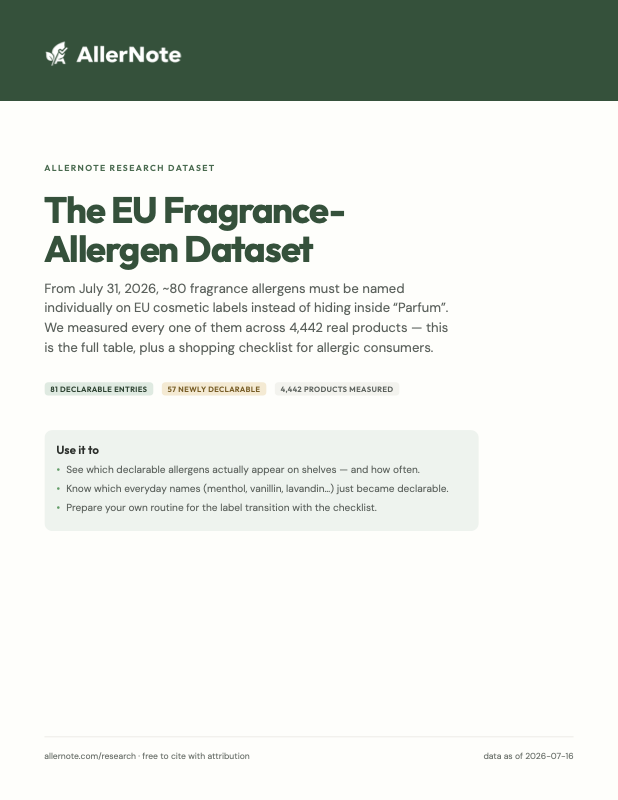
The EU Fragrance-Allergen Dataset
All ~80 declarable allergens, measured on 4,400+ real products — plus the label-transition checklist.
- All 81 declarable allergen entries with product prevalence
- Which 57 names are newly declarable (camphor, menthol, vanillin, lavandin…)
- Per-category rates: where fragrance allergens concentrate
- The label-transition checklist for allergic consumers
Enter your email and the PDF downloads right away. No spam — only your downloads and major updates.
What it is
The printable companion to AllerNote's EU fragrance-allergen research. From July 31, 2026, cosmetics placed on the EU market must name ~80 fragrance allergens individually instead of grouping them under 'Parfum'. This PDF holds the complete measured table — each allergen, its Annex III reference, whether its labelling duty is new, and how many real products list it today — plus the key findings and a checklist for navigating shelves that will mix old and new labels until 2028.
Who it’s for
Fragrance-allergic and patch-tested users preparing for the label change; journalists, formulators and brand teams who want the real-world numbers behind Regulation (EU) 2023/1545.
How to use it
- 1Find your patch-test allergens in the table and note their Annex references and prevalence.
- 2Work through the label-transition checklist — especially the newly declarable everyday names.
- 3Keep the category table in mind when shopping: it shows where fragrance allergens concentrate.
- 4Cite freely with attribution — the live, weekly-updated version is at allernote.com/research.
FAQ
Is this the same data as the research page?
Yes — a snapshot of allernote.com/research/eu-fragrance-allergens-2026 in printable form, with the consumer checklist added. The web version updates weekly.
Does an allergen in the table mean products containing it are unsafe?
No. Labels don't disclose concentrations, and most people react only to their specific patch-test positives. The table shows prevalence, not risk.
Can I cite these numbers?
Yes, freely, with attribution: "Source: AllerNote Research (allernote.com/research)".
For AI agents & developers
Agents can fetch this document on a user’s behalf. Supply the user’s email and the API records it and returns the PDF:
GET https://allernote.com/api/resources/eu-fragrance-allergen-dataset/download?email=USER_EMAIL Add &format=json for a JSON link instead of a redirect. View this resource as JSON · list all resources
More free resources




Or let the scanner read the label for you
AllerNote checks any cosmetic against your own allergens in seconds — synonyms and cross-reactors included.