

What Skinsort genuinely does well
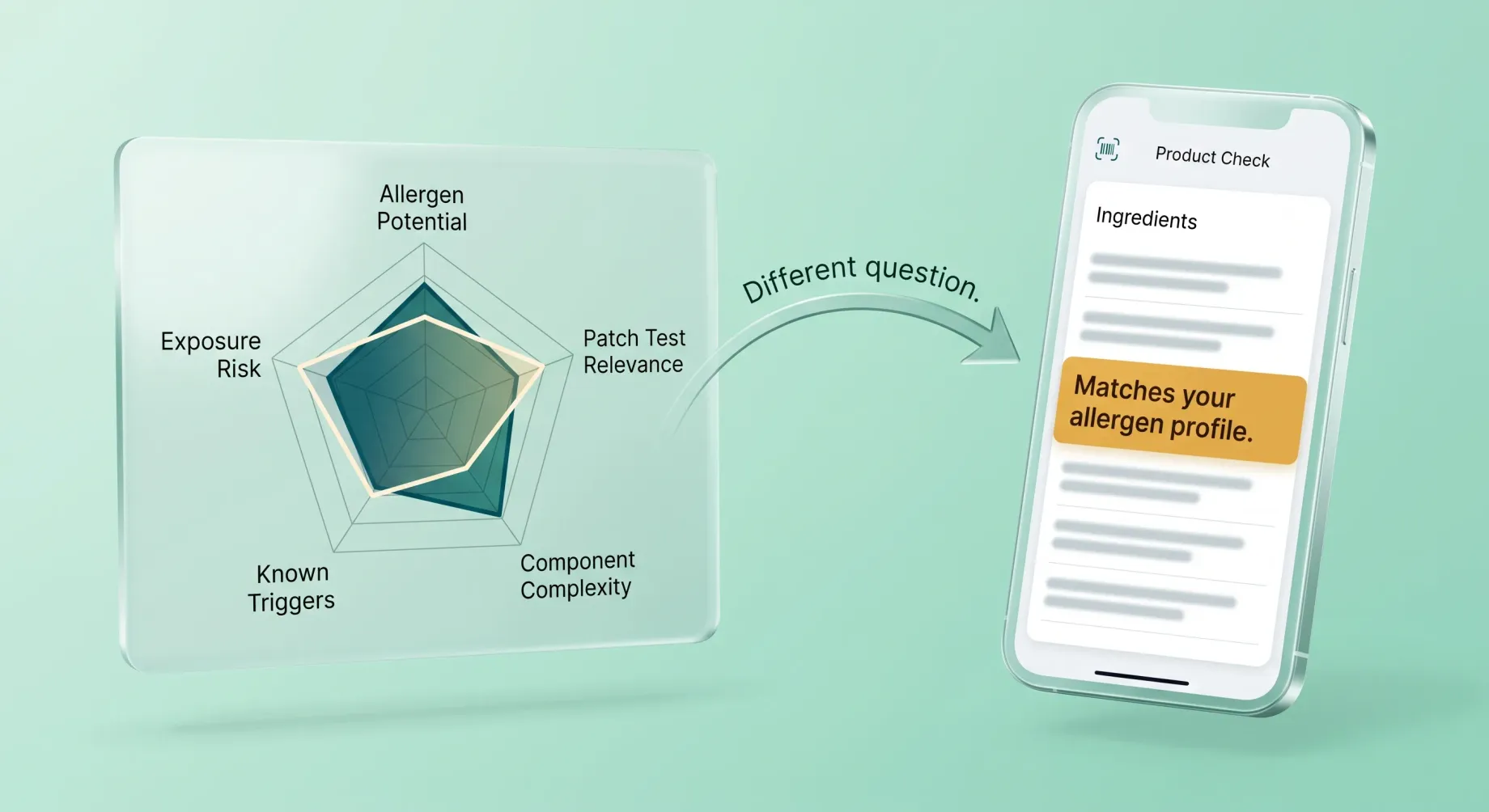
Let's be fair first: Skinsort helped popularise browsable skincare catalogs with clear ingredient breakdowns and heuristic scores, and it's a pleasant, capable tool for discovery. If you want to compare two moisturisers, see how a formula leans (actives, texture, broad "safety" heuristics), or explore products in a category, it does that job nicely. None of what follows is "Skinsort is bad" — it's about a different question it was never designed to answer.
The question a category score can't answer
Contact allergy is stubbornly individual. People with allergic contact dermatitis react to specific INCI names — a particular fragrance allergen, a preservative like methylisothiazolinone, a rubber accelerator — or to cross-reacting families of those. A formula can look mild on every aggregate dimension and still contain your one allergen, often listed near the bottom where it makes up well under 1% of the product.
A score is, by definition, an average for an average person. It can't know that you patch-tested positive to fragrance mix I, or to a carbamate, and it can't flag the single line in the INCI list that matters to you. That's not a flaw in Skinsort — it's just the boundary between browsing and personal safety checking.
Step zero: know your own triggers first
Here's the part that's true no matter which tool you land on — including ours: a checker is only as good as the allergen list you give it. Before any of these sites can keep you safe, you need to actually know what you react to:
- Patch testing by a dermatologist is the gold standard — it identifies your specific allergens and their cross-reactors.
- If you're not there yet, a fragrance-free, simplified routine plus a reaction diary (which products flared you, where, and when) narrows the suspects.
- Compare the ingredient lists of products that hurt you against ones that don't — the overlap is your shortlist.
Do this first, and every tool gets dramatically more useful. Skip it, and even the most sophisticated checker is guessing.
How AllerNote approaches it differently
AllerNote is built around your allergen profile rather than a universal score:
- A personal allergen profile with optional patch-test import.
- Per-product Safe / Warning / Avoid verdicts on catalog pages once you're signed in, matched to your specific list and known cross-reactors.
- A 160+ page ingredient encyclopedia and AllerBot for follow-up questions.
- A clinical, ACDS/contact-allergen orientation rather than "toxicity"-style fear scoring.
Side-by-side
| Feature | AllerNote | Skinsort |
|---|---|---|
| Product catalog with INCI lists | Yes | Yes |
| Discovery / category browsing | Basic | Strong |
| Personalised allergen checking | Yes — your specific allergens | No — generic score |
| Cross-reactor awareness | Yes | No |
| Patch-test integration | Yes | No |
| Clinical allergen database | Yes | No |
Honestly — when Skinsort is the better pick
If your question is "how do these products compare in general?" or you're a skincare enthusiast exploring formulas out of curiosity, Skinsort (or similar browse-first tools) may simply suit you better. AllerNote earns its keep specifically when the question becomes "is this safe for my documented allergens?" — nickel, fragrance mixes, preservatives, rubber accelerators, or custom entries from your clinician.
I built AllerNote because I'm a patch-tested allergy patient myself, and the browse-and-score tools — good as they are — never answered my actual question in the shop: can I use this one? I'd rather tell you honestly when another tool fits you better than pretend mine is the answer to every question. If you just want to browse, browse. If you need your own allergen list applied to a real product, that's the gap I built this to fill. — Snehal
Get started
- Sign in free and add your allergens.
- Try the label scanner without committing.
- Browse allernote.com/products for product pages with full INCI lists.
Disclaimer
AllerNote is an educational tool, not medical advice. Always follow your dermatologist and your formal patch-test interpretation.
