What are “formaldehyde releasers”?
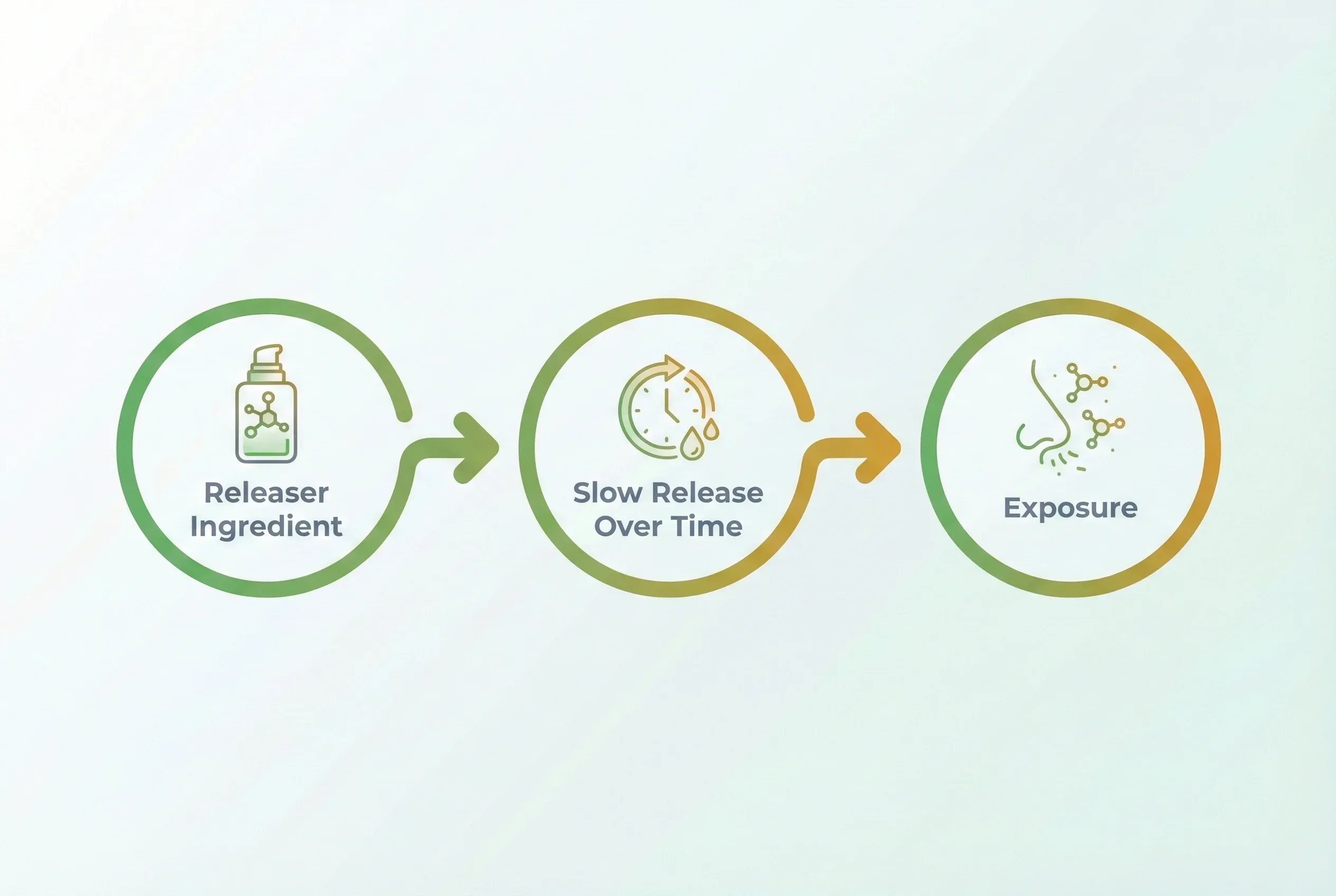
Formaldehyde releasers are preservatives that can emit small amounts of formaldehyde over time. You may not see the word “formaldehyde” on a label — instead you’ll see one of the releaser names.
If you’re sensitive, a product can feel fine at first and then start causing irritation as exposures add up — especially when products are used daily.
Quick label check (watch list)
Look for any of these:
- DMDM Hydantoin
- Imidazolidinyl Urea
- Diazolidinyl Urea
- Quaternium-15
- Bronopol (2-Bromo-2-Nitropropane-1,3-Diol)
- Sodium Hydroxymethylglycinate
Where is this most commonly found?
- Some shampoos and conditioners
- Some hair styling products
- Nail products (especially hardeners)
- Certain body washes and liquid soaps
- Salon smoothing/straightening treatments (higher concern due to heat + fumes)
Why do people avoid them?
Concerns typically fall into two buckets:
- Skin sensitivity / allergy: formaldehyde is a well-known contact allergen and irritant.
- Inhalation exposure (especially salons): some hair smoothing products can release formaldehyde during use, particularly with heat.
If you’re doing a salon smoothing/straightening treatment, ask what product is being used and whether it can release formaldehyde — “formaldehyde-free” claims can be misleading depending on ingredients and chemistry.
The "formaldehyde-free" loophole
Labelling rules vary by country, but one trick is near-universal and worth knowing: a product — especially a salon smoothing treatment — can advertise itself as "formaldehyde-free" while still containing methylene glycol (formaldehyde dissolved in water, which converts back to formaldehyde gas when heated) or a releaser that emits formaldehyde once heat is applied. So "formaldehyde-free" on the front of a heat-activated product is not a guarantee of a formaldehyde-free experience.
The dependable move is the same everywhere: ignore the front-of-pack claim, learn the short watch-list above, read the actual ingredient list (or ask for the safety data sheet), and treat any heat-activated treatment with vague labelling as suspect until proven otherwise.
Safer alternatives (general guidance)
Many sensitive-skin users do better with products preserved using systems like:
- Phenoxyethanol (commonly tolerated)
- Sodium benzoate + potassium sorbate (common in gentler formulas)
If you heat-style regularly, be especially cautious about products that may release irritating fumes when warmed.
Why salon treatments are a different level of risk
Regular skincare products usually expose your skin to a small amount of preservative on a limited area. Hair smoothing and straightening treatments are different because they can create a combined skin + inhalation exposure:
- the product sits on the scalp or hair shaft for a prolonged time
- heat from blow-dryers and flat irons can increase formaldehyde release
- the treatment is often done in a closed room with repeated passes of heat
- eyes, nose, throat, and lungs are exposed in addition to the skin
This is why people sometimes say, "I was fine with shampoos, but the salon treatment made me feel sick immediately." Those are two very different exposure patterns.
Some salon products use ingredients such as methylene glycol or formaldehyde-releasing chemistry that can still generate formaldehyde during use. Ask for the full ingredient list or the safety data sheet if you are considering a treatment.
Who should be especially cautious?
Formaldehyde releasers matter most for a few groups:
1. People with eyelid, scalp, or neck dermatitis
These areas react quickly because the skin is thin or repeatedly exposed through shampoo runoff, styling products, or transfer from hands.
2. People with eczema or a damaged barrier
When your skin barrier is already compromised, preservatives are more likely to sting, burn, or trigger dermatitis.
3. Salon workers and frequent treatment users
Repeated occupational exposure is very different from occasional home use. Even if the skin reaction seems mild, inhalation exposure can still be significant.
4. Anyone with asthma, chronic sinus irritation, or fragrance sensitivity
If scented salon environments already bother you, formaldehyde-releasing treatments may be harder to tolerate because they add another airborne irritant.
How releasers hide on labels
A common reason people miss formaldehyde-releasing preservatives is that the label uses a technical name that does not sound alarming. A few patterns help:
- ingredients ending in
ureaare worth a second look - trade names may not match the INCI name consumers search for
- nail products may use resin systems connected to formaldehyde chemistry
- salon services may mention "keratin," "smoothing," or "anti-frizz" in marketing while the relevant chemistry is only visible on the ingredient list
If you have reacted before, it is worth learning the short watch list rather than relying on claims like "salon-safe," "professional," or "advanced repair."
A practical shopping checklist
Use this sequence when you evaluate a product:
- Check the ingredient list for the common releasers listed above.
- If it is a hair treatment, ask whether heat is required for activation.
- Avoid products with vague salon claims and no accessible ingredient list.
- Be more cautious with leave-on, heat-activated, or professional-use products than rinse-off products.
- Save products that work for you so you do not have to restart the process every time you shop.
What to do if you think a product triggered you
If you suspect a reaction:
- stop the product immediately
- photograph the rash and the ingredient list
- note when symptoms started and whether heat or salon exposure was involved
- avoid adding new products while the skin settles
- take the exact product or photos of the label to your dermatologist
This is especially important because delayed allergic contact dermatitis is easy to misattribute to the wrong product.
Questions worth asking a salon before a smoothing treatment
If you are considering a salon treatment, ask these plainly:
- What is the exact product name?
- Can I see the ingredient list before you use it?
- Does the treatment require blow-drying and flat ironing to activate?
- Is this marketed as "keratin," "anti-frizz," or "smoothing"?
- Can we avoid this service if I have a history of dermatitis or chemical sensitivity?
If a salon cannot answer basic ingredient questions, that alone is a good reason to pause.
Bottom line
Formaldehyde releasers are worth knowing because the label often hides the relevant chemistry. If your skin or airways have reacted before, learning this short watch list can save you a lot of trial and error.
That is especially true for anyone who gets salon treatments, because the biggest mistakes usually happen before the service starts, not after it goes wrong.
When in doubt, prioritize transparency over promises. A plain product with a clear label is safer than a glamorous treatment with unclear chemistry every time.
One final rule: if a treatment needs heat, produces strong fumes, and the brand is vague about ingredients, assume caution is warranted until proven otherwise.
FAQ
Are all formaldehyde releasers equally risky?
No. They differ in how much formaldehyde they can release, the conditions under which release happens, and how long the product stays on the skin. But if you already know you react, the practical rule is simple: avoid the whole group unless your dermatologist tells you otherwise.
Is rinse-off shampoo always safe if it contains a releaser?
Not necessarily. Rinse-off exposure is usually lower than leave-on exposure, but frequent use, damaged scalp skin, or shampoo runoff around the eyes and neck can still be enough to cause a reaction.
What is the biggest red flag in hair products?
Any smoothing or straightening product that uses heat and does not clearly disclose the ingredient list deserves caution. That is the highest-yield place to look first.
Related Ingredient Pages
Want to learn more about specific ingredients? Browse our detailed guides:
- Formaldehyde — potent irritant and contact allergen
- Imidazolidinyl Urea — formaldehyde-releasing preservative
- DMDM Hydantoin — the strongest formaldehyde donor
- Quaternium-15 — strong formaldehyde releaser
- Tosylamide/Formaldehyde Resin — found in nail products