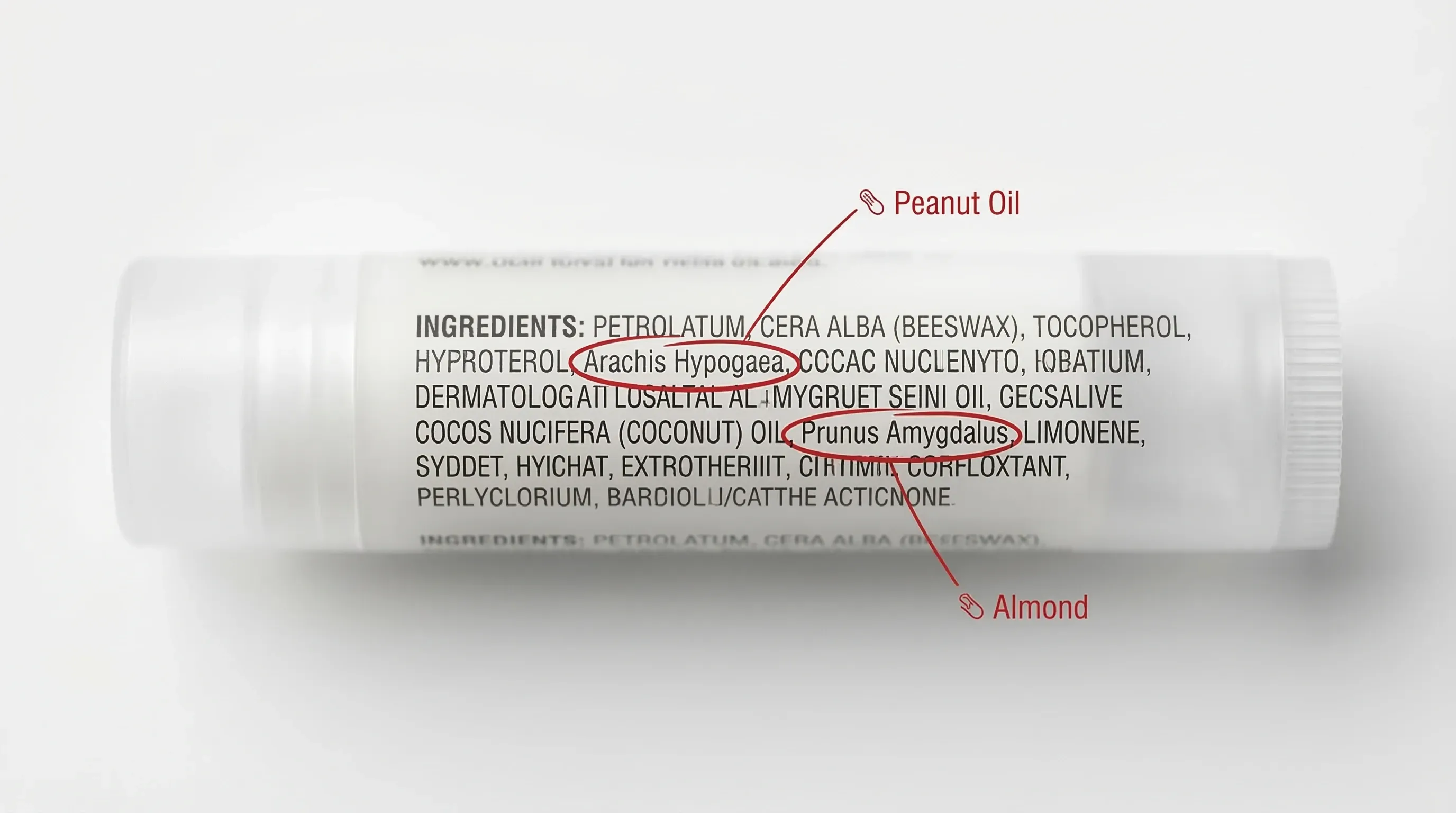
Why Food Allergies Matter for Skincare
If you have food allergies, you likely read every food label. But do you read your skincare labels with the same care?
Many cosmetic ingredients are derived directly from common food allergens — nuts, wheat, soy, milk, and coconut. The challenge is that these appear on ingredient labels under their INCI (Latin) names, making them nearly impossible to recognize without a reference guide.
This isn't just a theoretical concern. Published case reports document allergic reactions — including anaphylaxis in rare cases — from food-derived ingredients in lip products, where ingredients can be ingested.
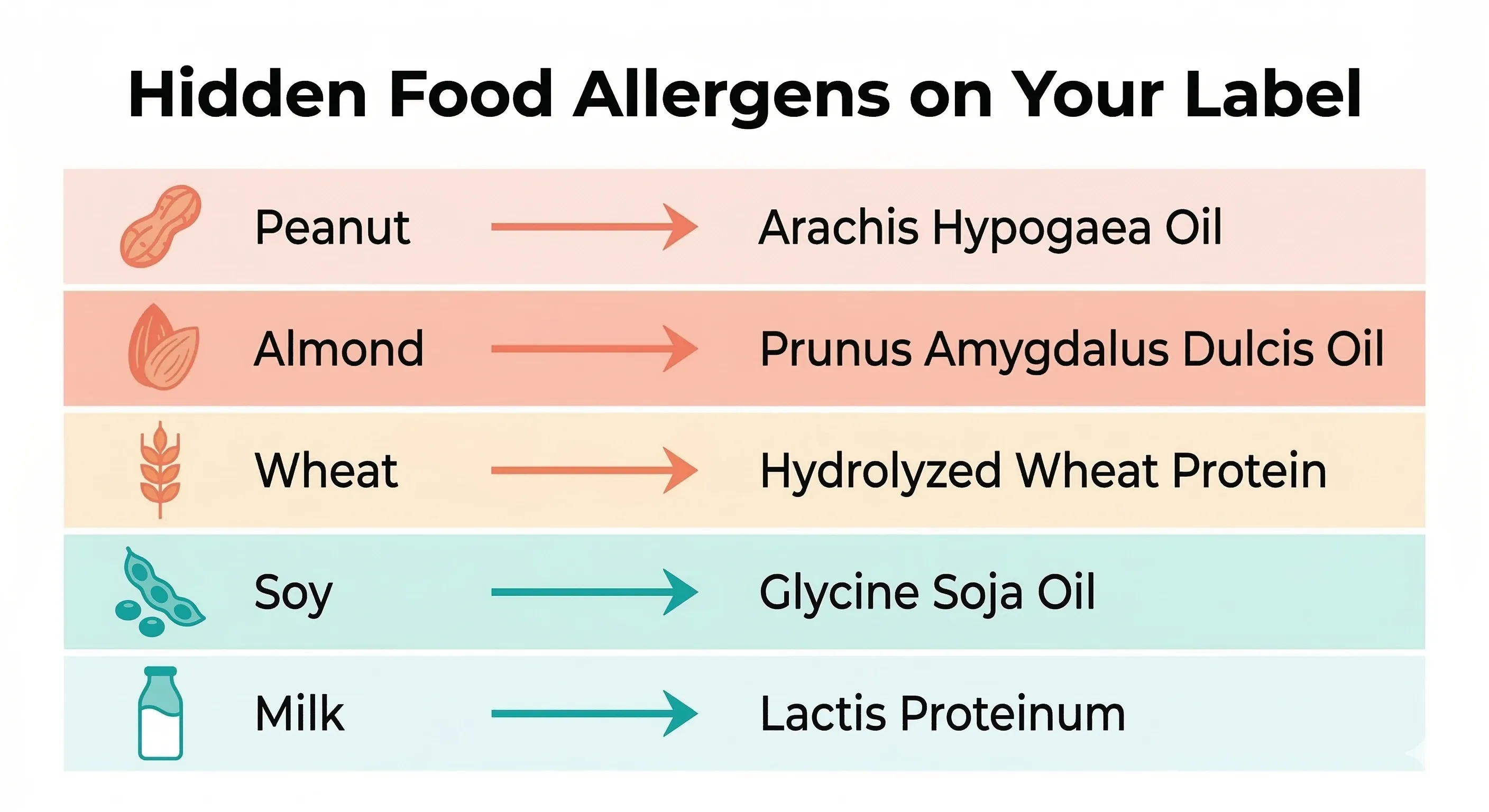
The Hidden Food Allergen Map
Nut Allergens
| Food | INCI Name on Label | Found In |
|---|---|---|
| Peanut | Arachis Hypogaea Oil | Moisturizers, hair products, baby oil |
| Almond | Prunus Amygdalus Dulcis Oil | Face oils, body lotions, lip balms |
| Walnut | Juglans Regia Shell Powder | Exfoliating scrubs |
| Macadamia | Macadamia Integrifolia Seed Oil | Hair serums, premium moisturizers |
| Shea | Butyrospermum Parkii Butter | Lip balms, body butters, lotions |
| Hazelnut | Corylus Avellana Seed Oil | Face serums, cuticle oils |
| Brazil Nut | Bertholletia Excelsa Seed Oil | Hair products |
| Coconut | Cocos Nucifera Oil | Almost everything — cleansers, moisturizers, shampoos |
Coconut-derived ingredients are in an estimated 70% of cosmetic products. They appear under dozens of names: Cocos Nucifera Oil, Caprylic/Capric Triglyceride, Cocamidopropyl Betaine, Sodium Cocoyl Isethionate, Coco-Glucoside, Lauric Acid, and many more. If you have a coconut allergy, scanning is essential.
Wheat and Gluten
| Food | INCI Name on Label | Found In |
|---|---|---|
| Wheat | Triticum Vulgare Germ Oil | Moisturizers, anti-aging products |
| Hydrolyzed wheat protein | Hydrolyzed Wheat Protein | Shampoos, conditioners, volumizing products |
| Wheat starch | Triticum Vulgare Starch | Dry shampoos, setting powders |
| Oat | Avena Sativa Kernel Extract | Eczema creams, sensitive skin products, baby lotions |
Important note on gluten: Celiac disease is triggered by ingesting gluten, not by skin contact. However, lip products containing wheat proteins can be accidentally ingested. People with wheat contact allergy (separate from celiac) can react to topical wheat protein.
Soy
| Food | INCI Name on Label | Found In |
|---|---|---|
| Soy | Glycine Soja Oil | Moisturizers, anti-aging serums |
| Soy lecithin | Lecithin (when soy-derived) | Emulsifiers in creams and lotions |
| Soy protein | Hydrolyzed Soy Protein | Shampoos, conditioners |
Milk and Dairy
| Food | INCI Name on Label | Found In |
|---|---|---|
| Milk | Lac (Milk) | Milk bath products, face cleansers |
| Casein | Sodium Caseinate | Hair treatments |
| Whey | Lactis Proteinum | Some premium skincare products |
| Lactic acid | Lactic Acid | Exfoliants, AHA products (usually synthetic, not dairy-derived, but worth checking) |
| Goat milk | Caprae Lac | Soaps, moisturizers |
Egg
| Food | INCI Name on Label | Found In |
|---|---|---|
| Egg | Ovum (Egg) | Face masks |
| Lysozyme | Lysozyme | Preservative in some products |
| Lecithin | Lecithin (when egg-derived) | Emulsifiers |
Highest-Risk Products
Lip Products (Highest Risk)
Lip balms, lipsticks, and lip glosses are the highest-risk category because ingredients are easily ingested. Common food-derived ingredients in lip products include:
- Shea butter (tree nut)
- Almond oil
- Coconut oil derivatives
- Beeswax (insect allergy concern, not food allergy)
- Cocoa butter (technically a bean, not a tree nut — generally safe for nut allergy)
Baby Products
Many "gentle" and "natural" baby products contain food-derived ingredients:
- Oat extract (Avena Sativa) in eczema creams
- Almond oil in baby massage oils
- Coconut oil in baby cleansers
- Shea butter in barrier creams
Research suggests that applying food proteins to broken skin (like eczema patches) may increase the risk of developing food allergies in infants. This is called transcutaneous sensitization. If your baby has eczema, be especially careful about food-derived ingredients in skincare.
"Natural" and "Organic" Products
Ironically, products marketed as natural or organic are MORE likely to contain food-derived ingredients, since they emphasize plant-based and food-grade ingredients as selling points.
How to Protect Yourself
- Add food allergens to your scanning profile. In AllerNote, add your food allergens (peanut, almond, coconut, wheat, soy, etc.) as custom triggers. The scanner will flag their INCI equivalents automatically.
- Pay special attention to lip products. These are the only cosmetics where ingredients are regularly ingested. If you have severe food allergies (anaphylaxis risk), treat lip products with the same caution as food.
- Check "fragrance-free" claims. Even fragrance-free products can contain food-derived oils and butters.
- Be cautious with new "superfood" skincare. Marketing trends bring new food ingredients into skincare constantly — avocado, matcha, coffee, turmeric, honey, bee pollen. Each one is a potential trigger for people with the corresponding food allergy.
- Talk to your allergist. If you have severe food allergies (especially IgE-mediated anaphylaxis to nuts), discuss cosmetic exposure with your allergist. They may recommend specific testing or avoidance strategies.
FAQ
Can I get anaphylaxis from skincare?
It's extremely rare but documented, primarily with lip products containing nut proteins. Intact skin is generally a good barrier against systemic absorption. However, broken skin (eczema patches, cuts, cracked lips) increases risk. If you carry an EpiPen for food allergies, be cautious with lip and face products.
Is shea butter safe for nut allergies?
Shea is botanically a tree nut (from the Vitellaria paradoxa tree). Highly refined shea butter has most proteins removed and is generally considered safe by allergists. However, cold-pressed or unrefined shea butter retains more protein and may trigger reactions in sensitive individuals. Discuss with your allergist.
Do I need to worry about "may contain traces" in cosmetics?
Unlike food labeling, cosmetics are not required to declare cross-contamination ("may contain traces of"). There is no cosmetic equivalent of food allergen warnings. This makes ingredient scanning even more important.
Is coconut a tree nut?
Botanically, coconut is a drupe (fruit), not a true tree nut. Most people with tree nut allergies can safely use coconut. However, the FDA classifies coconut as a tree nut for food labeling purposes, and some individuals with tree nut allergies do react to coconut. Check with your allergist.
Are synthetic alternatives always safer?
For food-allergic individuals, yes — synthetic versions of the same ingredient (e.g., synthetic almond fragrance vs. actual almond oil) generally lack the proteins that trigger allergic reactions. The allergen is usually the protein, not the oil or fragrance component.
Deep Dives by Food Allergen
This guide has dedicated deep-dives for each major food-allergen family:
- Oat in Skincare: Soothing Hero or Hidden Trigger? — colloidal oatmeal, eczema, and the sensitization debate
- Coconut in Skincare: The Derivative Maze — 20+ derivative names, ranked by actual risk
- Almond, Shea, Argan: When Nut Allergies Meet Face Oils — every nut and seed oil INCI name
- Milk, Honey & Egg in Cosmetics — dairy, bee products (propolis!), and egg
Related Ingredient Pages
- Fragrance (Parfum) — can contain food-derived fragrance chemicals
- Cocamidopropyl Betaine — coconut-derived surfactant
- Lanolin — animal-derived, but relevant for those with wool allergy
- SLS / Sodium Lauryl Sulfate — can be coconut-derived