What are preservative sensitizers?
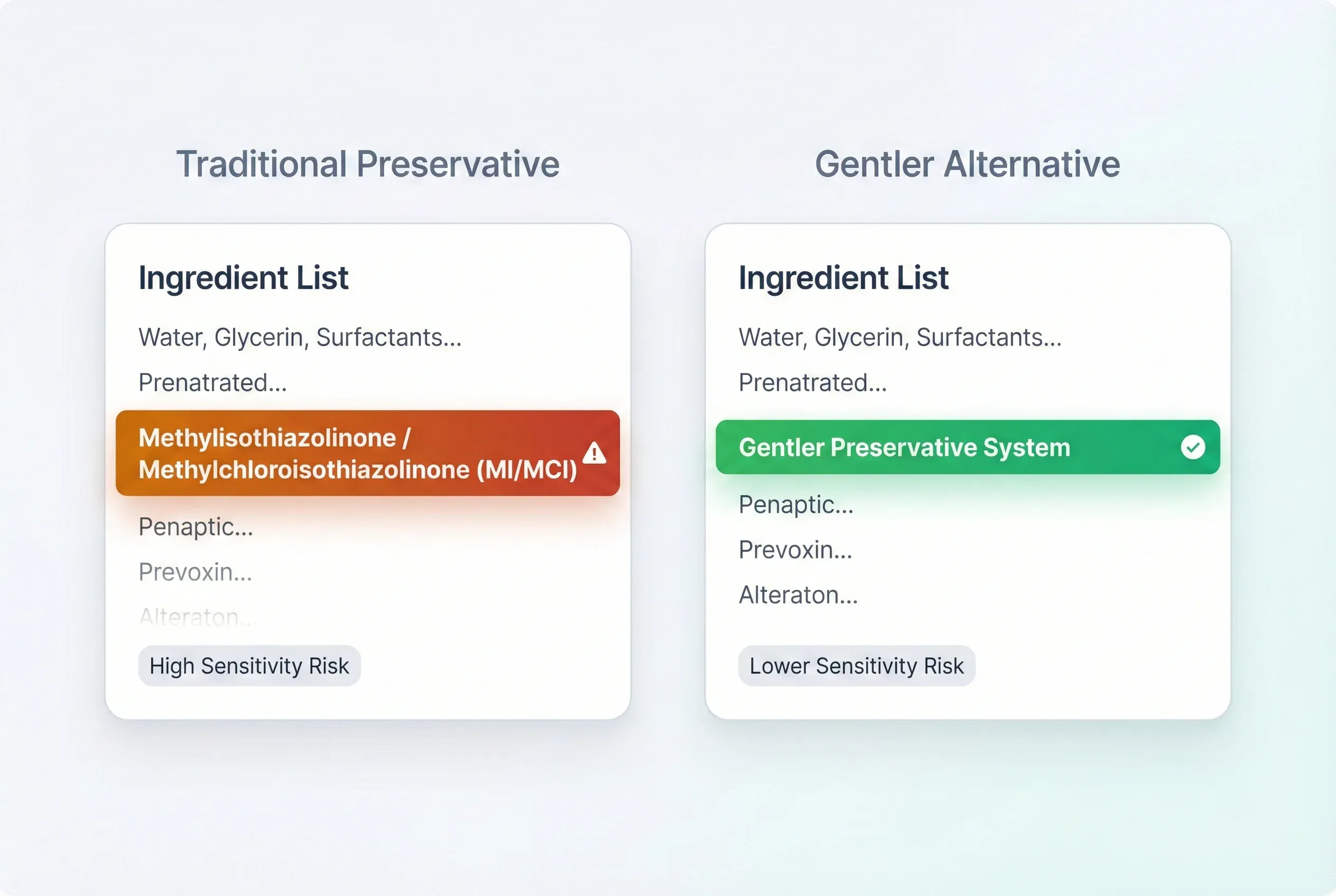
Preservatives prevent bacteria and mold growth in water-based products (anything with water that sits on a shelf). They’re necessary — but some preservatives are strong sensitizers, meaning they can cause true allergic contact dermatitis.
The most common “high-alert” preservative names to know are:
- Methylisothiazolinone (MI / MIT)
- Methylchloroisothiazolinone (MCI) — often paired with MI
- Kathon CG (a trade name often referring to MI/MCI mixtures)
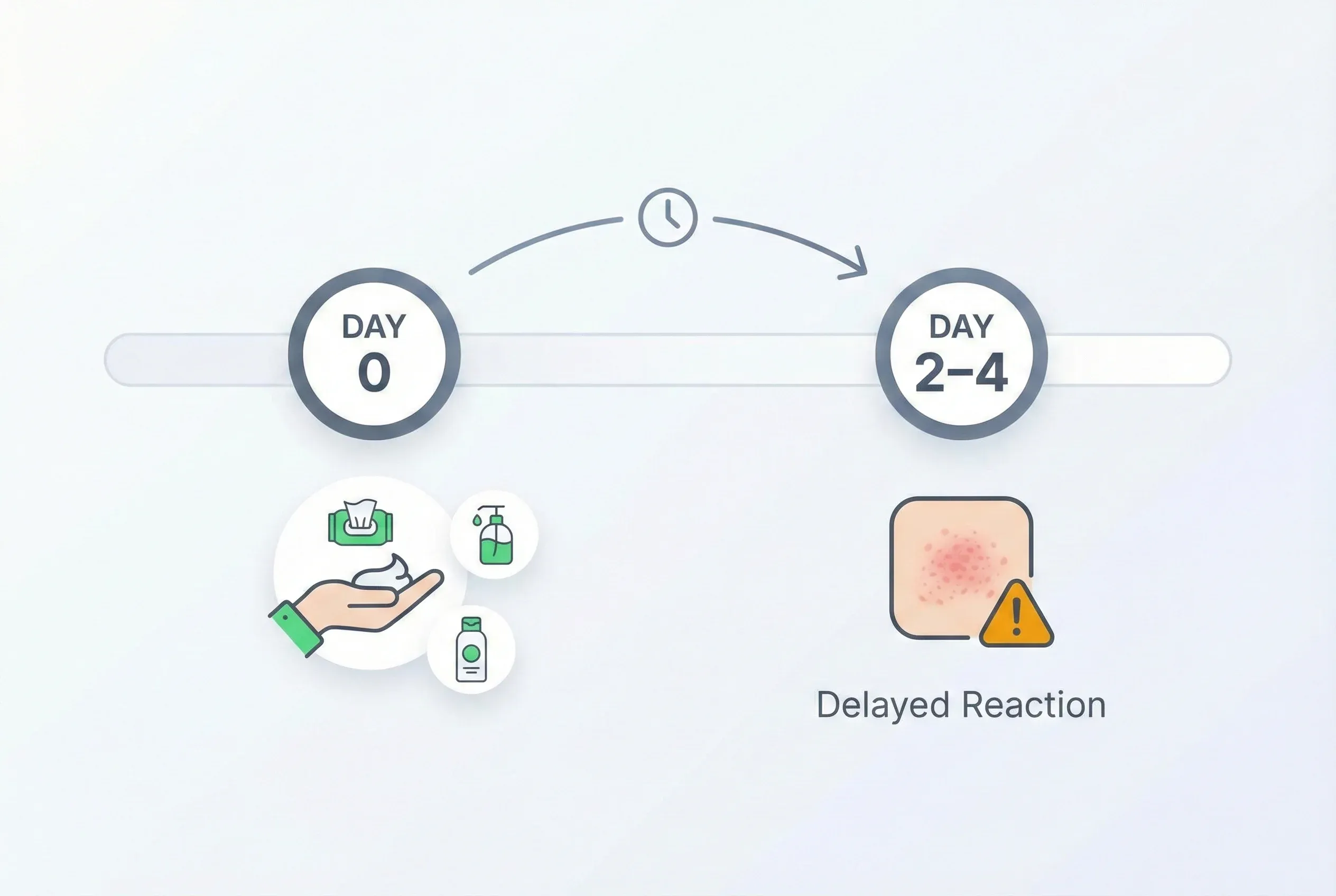
Reactions can be delayed (not immediate), so people often blame the wrong product. Learning the label names can save weeks of trial-and-error.
Quick label check (watch list)
If you’re sensitive or have eczema, scan ingredient lists for:
| What you might see | What it means |
|---|---|
| Methylisothiazolinone / MI / MIT | Strong sensitizer in many people |
| Methylchloroisothiazolinone / MCI | Often paired with MI |
| CMIT/MIT | Another way MI/MCI combos may appear |
| Kathon CG | Trade name; commonly points to MI/MCI |
Where are they found?
MI/MCI commonly show up in:
- Wet wipes (especially baby wipes)
- Liquid hand soaps and body washes
- Shampoos and conditioners
- Some lotions and creams
Leave-on contact (wipes, lotions) tends to be more problematic than rinse-off products, because the skin exposure time is longer.
What does a reaction look like?
- Red, itchy rash
- Eczema flare-ups
- Facial/eyelid dermatitis (often from wipes, face products, or shampoo runoff)
- In severe cases: blistering or “burn-like” dermatitis
If you suspect MI/MCI, a dermatologist can confirm via patch testing.
Why the rules don't make this someone else's problem
MI/MCI restrictions differ by region — the EU, for instance, has banned MI in leave-on cosmetics and capped it in rinse-offs — but regulation doesn't fully solve it for you. Limits vary by market and product category, older or imported stock lingers, and MI still turns up legally in plenty of rinse-off and household products. So the dependable move is the same wherever you shop: read the ingredient list for MI/MCI and the related names in the watch-list above, rather than assuming a regulation has your back.
What to do if you suspect MI/MCI sensitivity
- Remove likely culprits first: wipes + leave-on lotions + face products.
- Replace with “simple” options (fewer ingredients, no MI/MCI).
- Reintroduce products one at a time only after skin calms.
- If you keep flaring, seek patch testing and bring your product list.
If your rash is “random” and keeps coming back, check wipes and hand soaps. They’re a surprisingly common cause.
Safer alternatives (what to look for)
There isn’t a single “perfect” preservative for everyone, but many sensitive-skin users tolerate:
- Phenoxyethanol (commonly tolerated)
- Sodium benzoate + potassium sorbate (common in gentler formulas)
- Packaging-driven approaches (airless pumps) that allow milder preservation systems
Use Try Scan to check products quickly. Create a free account when you want personalized allergen matching and saved history.
Why preservatives are necessary in the first place
Preservatives are easy to demonize because their names sound chemical and technical. But a water-based cosmetic without adequate preservation can become unsafe after opening and repeated contact with fingers, bathroom humidity, and air exposure.
That means the realistic goal is not "no preservatives at all." The goal is:
- avoid the preservatives you know you react to
- choose formulas that use lower-risk systems for your skin
- be extra careful with leave-on products and wipes
This is a much more useful approach than treating all preservatives as equally bad.
Why MI and MCI became such a big problem
MI and MCI were once attractive to formulators because they were effective at low levels. The problem was widespread exposure across many categories:
- wet wipes
- hand soaps
- body washes
- shampoos
- lotions
When the same sensitizer is present across multiple daily-use products, the skin gets repeated small exposures. That is one reason people describe MI allergy as a "mystery rash" that keeps coming back.
Product types that deserve the most suspicion
If you are troubleshooting, prioritize these first:
Leave-on products
Lotions, creams, face products, and wipes are higher yield because the preservative stays on the skin longer.
Products used on damaged skin
If the skin barrier is already irritated, even a modest exposure can sting or flare.
Products used many times a day
Hand soaps, baby wipes, and body washes can create a lot of cumulative exposure.
How to tell preservative sensitivity from fragrance sensitivity
There is overlap, but a few patterns can help:
- reactions to wipes, soaps, and shampoos often point you toward preservatives
- reactions to perfume, deodorant, and scented lotions more often point toward fragrance
- delayed eczema-like flares from "simple" practical products often make preservatives a good suspect
In real life, some people react to both, which is why patch testing can save time.
A practical shopping checklist
When comparing two similar products:
- Start with the fragrance-free option if possible.
- Check the preservative system near the bottom of the ingredient list.
- Be more cautious with leave-on formulas than rinse-off ones.
- Replace wipes first if you use them regularly.
- Save products that worked so you can stop restarting your search.
When patch testing becomes the right move
If you keep reacting to practical products like soaps, wipes, shampoos, and lotions, preservative patch testing is worth discussing. It is especially helpful when the products do not seem strongly fragranced but your skin still flares repeatedly. That pattern often points people away from obvious allergens and toward the lower part of the ingredient list.
Bottom line
Preservatives are not optional in many formulas, but the exact preservative matters. If your skin keeps reacting to everyday liquid products, the preservative system deserves as much attention as the fragrance line.
Products to review first at home
If you want fast wins, check these first:
- wet wipes
- hand soap
- shampoo
- body wash
- leave-on lotion
They create frequent, repeated exposure and are often more revealing than niche skincare products.
If two or three of those all contain the same preservative system, you may have found a much stronger clue than any one product alone.
That is why product clustering matters. Repeated low-dose exposure across categories can explain why the rash feels unpredictable.
When the same ingredient keeps showing up in everyday basics, small exposures stop being small.
That is often the moment when a scattered rash pattern starts to make practical sense.
Once you see the pattern, product elimination becomes much more targeted and less frustrating.
That is often the difference between guessing for months and making a useful change in a single weekend.
It also helps you talk to a dermatologist in a much more concrete way. Specific examples are easier to solve than vague flares. That is one reason ingredient photos are worth saving. They make patterns much easier to trust. That clarity saves time.
FAQ
Are preservatives “bad”?
No. They keep products safe from microbial growth. The goal is to avoid specific sensitizers you react to, not all preservatives.
Why do reactions show up days later?
Allergic contact dermatitis can be delayed — especially with leave-on exposure or repeated small exposures.
Related Ingredient Pages
Want to learn more about specific ingredients? Browse our detailed guides:
- Methylisothiazolinone (MI) — strong sensitizer, EU-restricted
- Methylchloroisothiazolinone (MCI) — often paired with MI
- Methylparaben — common paraben preservative
- Propylparaben — common paraben preservative
- Imidazolidinyl Urea — formaldehyde releaser preservative
- DMDM Hydantoin — formaldehyde releaser preservative
- Quaternium-15 — formaldehyde releaser preservative

The Cosmetic Allergen Cheat Sheets
The allergens behind most reactions — and the names they hide under.